Showing posts with label jazz. Show all posts

Thursday, November 30, 2017

Bringing Jazz Great Jimmie Lunceford’s legacy back to life

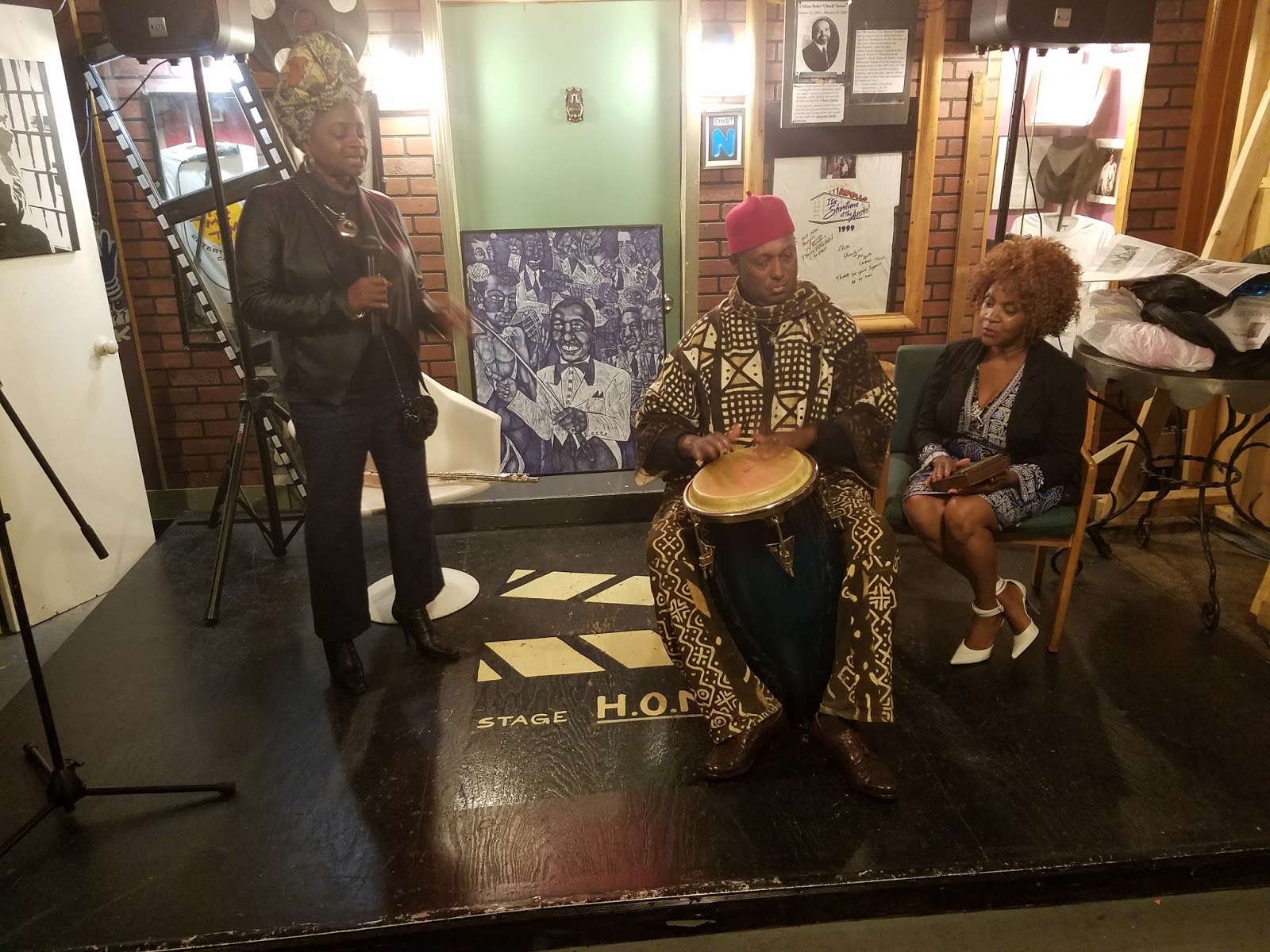
Caquita Monique sings, Ekpe Abioto plays the djembe drum, and Deborah Gleese
Barnes strokes the kalimba during The Jimmie Lunceford Jamboree Jazznocracy
Concert at the House of Mtenzi. (Photo by Wiley Henry)
The melodious jazz music that Jimmie Lunceford made famous during the swing era was buried with him in 1947 at historic Elmwood Cemetery in Memphis. The alto saxophonist and bandleader was only 45 years old when the music went silent.
Silence pervaded throughout the decades and Lunceford faded into obscurity – until an artist, musician, activist and historian discovered the maestro’s musicianship and his integrality to swing music nearly sixty years after his death.
In late October, however, Ronald Herd II was quite perturbed that his 10-year effort to raise awareness of Lunceford had largely gone unnoticed and that he wasn’t getting much traction.
He’d spoken to an intimate group of Lunceford devotees on Oct. 28 at the House of Mtenzi in Midtown Memphis minutes before the start of the Jimmie Lunceford Jamboree Jazznocracy Concert, which he produced primarily singlehandedly.
Jimmie Lunceford
The concert was part of the first annual seven-day Jimmie Lunceford Jamboree Festival that Herd – along with his mother, Callie Herd – founded to honor the legacy of the late extraordinary bandleader in order to secure his place in the annals of history and the world of jazz music.
He’d taken to social media to amp up visibility and awareness, which included radio interviews and news stories highlighting Lunceford’s contributions to Memphis and the music that inspired other jazz greats, such as Duke Ellington, Glenn Miller and Count Basie.
“After this week people probably will have heard more about Jimmie Lunceford than any time in the last 20 years, or even before then,” Herd told the group prior to the concert. “For a black man who had done so much, he deserves the honor.”
Since Herd had captured the attention of his audience – at times while punctuating his monologue with stinging rebuke – he encouraged those not already onboard to help bring Lunceford’s legacy back to life.
 “He was the epitome of greatness,” said Herd, chief executive artivist of The W.E. A.L.L. B.E. Group Inc., a nonprofit organization. “He was the real king of swing – not Benny Goodman. Glenn Miller said it best: ‘Jimmie Lunceford has the best of all bands. Duke [Ellington] is great, [Count] Basie is remarkable, but Lunceford tops them both.’”
The “artivist” was candid during his presentation of Lunceford and his exploits in music. “He was the number one band of choice for African Americans in the county. They called him the Harlem Express,” he said.
“Everybody wanted to be Jimmie Lunceford because he had this distinctive two-beat sound. Normally the other bands [during that era] had a four-beat sound,” said Herd, noting that Stax Records, Hi Records, and even Three-Six Mafia had emulated Lunceford’s two-beat rhythm.
A student of history, Herd compiles data and information and stores them in his memory bank. When the need arises, he retrieves them at a moment’s notice to express a point or to educate those who may be barren of facts.
Like, for example, James Melvin Lunceford (his name at birth) was born July 6, 1902, on a farm near Fulton, Miss., and learned to play several instruments as a child. He matriculated at Fisk University in Nashville and arrived in Memphis in 1927.
An accomplished musician by then, Lunceford took the job of athletic director at Manassas High School, where he organized a student band called The Chickasaw Syncopators. He later changed the name to The Jimmie Lunceford Orchestra.
The Orchestra soon rose to fame playing venues like The Apollo Theater in New York and The Cotton Club in Harlem, also in New York. He also toured extensively in Europe. But Lunceford was more than the music that he loved and shared with the world.
“He saw music as a rite of passage for young black boys and girls [to become] men and women,” said Herd. “He took the time to invest in people.”
Education and cultural awareness are essential to understanding Lunceford and the “excellence” of African Americans pursuing their dreams, he said.
“You must know where you come from and who your people are,” said Herd.
A brass note was dedicated to Lunceford on Beale Street in 2009.

Wednesday, December 23, 2015

A jazz jam celebration for Johnny Yancey

Jazz musicians young and old gathered at Circle Music Center to pay tribute to
their mentor, Johnny Yancey, who celebrated his 60th birthday. (Photos: Wiley Henry)
      Jazz trumpeter Johnny Yancey walked into Circle Music Center at 5124 Poplar Ave. Monday evening and heard a chorus shout “Happy 60th birthday, Johnny Yancey!” with jazz music teeming in the background.
“I don’t think I deserve this!” said Yancey, who actually turned 60 on Dec. 14. His wife Marcquinne, her mother Earlice Taylor, and Mike Kelley, a music historian and photographer, could not have disagreed more. The trio invited Yancey’s longtime friends and a cadre of jazz musicians that he’d jammed with over the course of 30 years to a combination birthday party and jazz jam celebration.
“I was totally surprised,” said Yancey. “My son Nygel told me that we had a gig to do. That’s what I thought I was going to.”
Old guys, young guys and new guys were all together.
Johnny Yancey prepares to cut his birthday cake. From left:
3-year-old Ari Yancey, Alaina Yancey, Nygel Yancey, Annese
Yancey and Amir West.
“We got people of all ages, diversity, high school, co-workers, friends and family,” said Marcquinne Yancey, who sang a silky smooth love song to her husband later on in the evening and then threw him a kiss.
The audience approved.
W. J. Michael Cody, former U.S. attorney for the Western District of Tennessee, listened intently while Yancey and his band-mates played syncopated beats on the drums and riveting chords on the piano. The wind and string instruments – saxophones, a trumpet, trombone and bass – moaned and whimpered.
 “I’ve known Johnny his entire life. His mother was a dear friend of mine,” said Cody. “I watched him grow up. I watched his career. And now I’ve seen his son Nygel come alone. He’s (Johnny) a wonderful person.”
The band played for four hours – totally unrehearsed yet in sync – with occasional vocal accompaniments from Taylor, a noted jazz, blues and gospel singer; Kellie Hurt Parker, a resident of Little Rock, who was accompanied by her husband Chris on piano; gospel artist Annie Ivory, director of Urban Family Ministries CDC, Inc.; and Todd Allen, a former Memphian now living in Atlanta.
The Rev. Renardo Ward, senior pastor of Greater Harvest Church of God in Christ, who also plays drums, called the assembled talent the “underground institution of jazz” and credited Yancey with birthing it in his home.
“Johnny has had a profound impact in Memphis for generations. I learned a lot from the University of Memphis, but I declare I learned a lot from Mr. Johnny Yancey,” he said.
The birthday host committee: Marcquinne Yancey, Mike
Kelley, a photographer and music historian, and Earlice
Taylor, a noted jazz, blues and gospel singer.
“I’m still learning myself,” said Yancey, giving props to his late brother, a saxophonist, who inspired him to play saxophone as well while in elementary school. At Southside High School, where he graduated in 1973, Yancey was introduced to jazz music and excelled.
Between then and now, he honed his jazz skills and learned to play other genres – gospel, classical, blues, reggae, and rhythm and blues – with relative ease and proficiency. He has performed with Alvin Baptiste, Billy Pierce, Donald Brown, Terri Lynn Carrington, Javon Jackson, James Williams, Herman Green, Zaid Nassar, the late Emerson Able Jr., Joyce Cobb, and Floyd Newman, who was in attendance.
“Floyd Newman was a great inspiration for me,” said Yancey, recalling the jam sessions with Newman at the old Bill’s Twilight Lounge, once a hub for African-American artists and writers on North Parkway before the building was razed in 2009.
Thad Jones, a jazz band conductor and trumpeter, also influenced Yancey, who formed his own jazz orchestra, The Sanctuary Jazz Orchestra, in 2002. That inaugural performance was a tribute to the late great composer, pianist and bandleader Edward Kennedy “Duke” Ellington.
Yancey and his orchestra have performed at a number of venues in Memphis and surrounding areas and accompanied Taylor in a benefit concert at Bridges of Memphis for mission charity relief in the Republic of Haiti.
Ward sees Yancey and his orchestra as a lynchpin that connects the Memphis jazz music scene to the world. He played with Yancey in the early days and said the bandleader was integral in shaping mindsets such as his own and bridging cultures with jazz music.
“He’s had people in the band from Haiti, Germany, Puerto Rico,” he said. “It’s international. It’s multicultural. The group spans generations from 9 years old and up. And he didn’t have a grant to fund the orchestra.”
Yancey said playing with the orchestra makes him feel happy.
“It’s an institution,” he said. “It’s no stress. They’re not obligated to do this. They do it because they love it.”
He loves it too – immensely – adding that his life-long mission is to pass the culture down to the younger generation, people who otherwise may not know that jazz is an integral part of African-American music history and the predecessor to other genres.
Quoting Art Blakey, a jazz drummer and bandleader who jammed with the likes of Fletcher Henderson and Billy Eckstine, Yancey said, “Jazz is the highest art form in the universe, because it comes from within and it tells a story, like an artist painting a picture or an actor playing a different role than his own personality.”

AT A GLANCE

·         Johnny and Marcquinne Yancey have been married 32 years.
·         They have three children: Annese, Alaina and Nygel, a freshman at the University of Tennessee at Knoxville majoring in Engineering. He also plays drums in his father’s band.

·         The couple has three grandsons: Ari, Demarrius and Amir.