Showing posts with label Manassas High School. Show all posts

Wednesday, April 13, 2022

Donated Prom Dresses Allow Girls an Opportunity to Shine

Jamie Thomas (center) and Kenosha Wallace, both 18-year-old graduating seniors at Manassas High School, look over a batch of dresses and gowns that Jacqueline F. Jordan donated for juniors and seniors attending the prom. Photo by Wiley Henry 

Jacqueline F. Jordan graduated from Manassas High School in 1973. But when her classmate Kenneth Allen called and asked for an in-kind donation, she responded posthaste. 

Jordan unloaded a closet-full of dry-cleaned dresses and gowns at the school on April 5 so some of the girls will have an opportunity to attend their high school prom in style on April 29.

“I know how it is when it comes to a day like that,” said Jordan, who is passionate about helping young people. “Whether you’re a junior or senior, you want to go to the prom because it’s special.”

Kaime Gadson, the school’s bridge math teacher and senior sponsor, met Jordan in the parking lot with a few of his students and carted nearly 20 garments and accessories into the building. This is his second year as senior sponsor.

The prom theme is Starry Nights. “What we’re looking for is some glitter, glamour and things of that nature,” said Gadson. “We want some pizzazz, some classiness as well, some flamboyance.”

Gadson wants the students to have a different look, a different feel for their prom experience, “not just your traditional prom,” he explained, and gave them leeway to pull it all together.

“From what was donated to us, I think there are a lot of pieces in there which the majority of the young ladies can pick from,” said Gadson, who’s taught for six years in the district, three of them at Manassas. 

The prom is an exciting time of year for juniors and seniors. It could be described as a rite of passage for many of them who’re eagerly awaiting the formal dance. It signifies the end of an era: 12 years of schooling. 

“It’s a very important time in their lives,” Jordan said. “So, it doesn’t bother me to share. I know how it is to want to go to the prom so bad and don’t have everything you need.”

Some of the girls may don their own evening gowns and accessories: corsages, jewelry, spike heels, and fancy hairstyles. The boys may sport a tuxedo and cummerbund or step out in a crisp suit and tie or a casual blazer. 

Jordan added to her donation of dainty garments a batch of jewelry for the girls and stylish shoes as well.

But some students and their parents may not be able to afford the price of a prom dress or a tuxedo if they’re relegated to a low-income status. The school, for example, is nestled in an area of North Memphis where decay is evident.

“Those prom dresses are a blessing to some girls, because some girls don’t have that type of money to provide their own prom dresses,” said Ariel Williams, a Southwest Tennessee Community College assistant who helps prepare students for college and life.

She works at Manassas twice a week and assists Gadson in his role as senior sponsor. “I can relate to the kids. I feel I know where they’re coming from,” said Williams, noting that the donated prom dresses are a great idea.

Whether the need is small or great, the Manassas Alumni Association has availed itself for years to lend a helping hand. Allen said it’s a way of giving back to the school and the community.

I've been involved with donating prom dresses and tuxedos for quite a few years now,” he said. “I just happen to have some ladies from different parts of town or in the family to donate the dresses that they have.”

The “brethren from Manassas [alumni]” have on occasion donated tuxedos, he pointed out. “We’ve had some of our alumni to pick the boys up and take them to the tuxedo shop to get them fitted.”

Allen said he’d be fulfilled when he sees the expression on the faces of the students, the appreciation in their voices, and the look in their eyes. 

“The prom is a memory that will last forever,” he said.

Thursday, November 30, 2017

Bringing Jazz Great Jimmie Lunceford’s legacy back to life

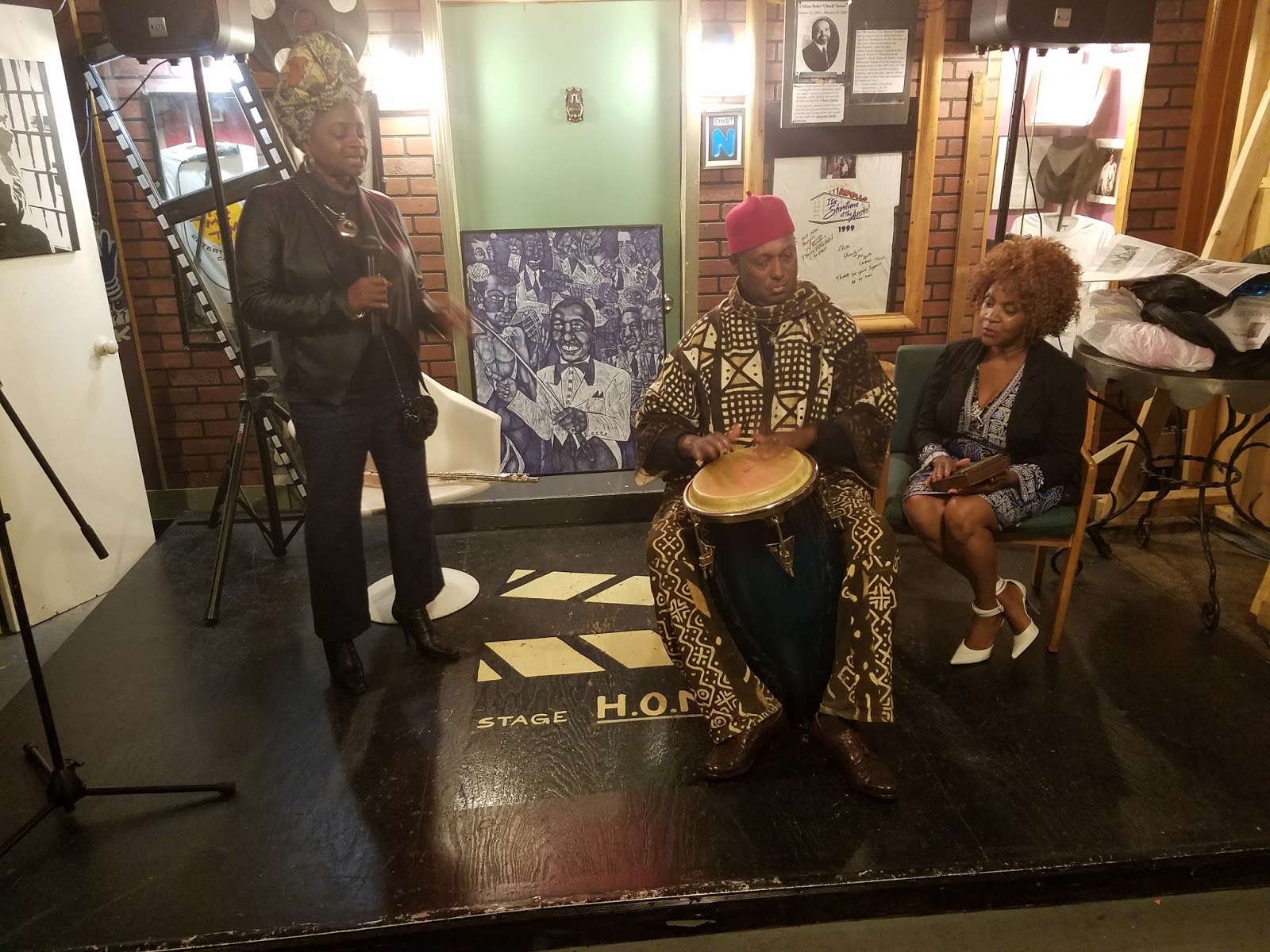
Caquita Monique sings, Ekpe Abioto plays the djembe drum, and Deborah Gleese
Barnes strokes the kalimba during The Jimmie Lunceford Jamboree Jazznocracy
Concert at the House of Mtenzi. (Photo by Wiley Henry)
The melodious jazz music that Jimmie Lunceford made famous during the swing era was buried with him in 1947 at historic Elmwood Cemetery in Memphis. The alto saxophonist and bandleader was only 45 years old when the music went silent.
Silence pervaded throughout the decades and Lunceford faded into obscurity – until an artist, musician, activist and historian discovered the maestro’s musicianship and his integrality to swing music nearly sixty years after his death.
In late October, however, Ronald Herd II was quite perturbed that his 10-year effort to raise awareness of Lunceford had largely gone unnoticed and that he wasn’t getting much traction.
He’d spoken to an intimate group of Lunceford devotees on Oct. 28 at the House of Mtenzi in Midtown Memphis minutes before the start of the Jimmie Lunceford Jamboree Jazznocracy Concert, which he produced primarily singlehandedly.
Jimmie Lunceford
The concert was part of the first annual seven-day Jimmie Lunceford Jamboree Festival that Herd – along with his mother, Callie Herd – founded to honor the legacy of the late extraordinary bandleader in order to secure his place in the annals of history and the world of jazz music.
He’d taken to social media to amp up visibility and awareness, which included radio interviews and news stories highlighting Lunceford’s contributions to Memphis and the music that inspired other jazz greats, such as Duke Ellington, Glenn Miller and Count Basie.
“After this week people probably will have heard more about Jimmie Lunceford than any time in the last 20 years, or even before then,” Herd told the group prior to the concert. “For a black man who had done so much, he deserves the honor.”
Since Herd had captured the attention of his audience – at times while punctuating his monologue with stinging rebuke – he encouraged those not already onboard to help bring Lunceford’s legacy back to life.
 “He was the epitome of greatness,” said Herd, chief executive artivist of The W.E. A.L.L. B.E. Group Inc., a nonprofit organization. “He was the real king of swing – not Benny Goodman. Glenn Miller said it best: ‘Jimmie Lunceford has the best of all bands. Duke [Ellington] is great, [Count] Basie is remarkable, but Lunceford tops them both.’”
The “artivist” was candid during his presentation of Lunceford and his exploits in music. “He was the number one band of choice for African Americans in the county. They called him the Harlem Express,” he said.
“Everybody wanted to be Jimmie Lunceford because he had this distinctive two-beat sound. Normally the other bands [during that era] had a four-beat sound,” said Herd, noting that Stax Records, Hi Records, and even Three-Six Mafia had emulated Lunceford’s two-beat rhythm.
A student of history, Herd compiles data and information and stores them in his memory bank. When the need arises, he retrieves them at a moment’s notice to express a point or to educate those who may be barren of facts.
Like, for example, James Melvin Lunceford (his name at birth) was born July 6, 1902, on a farm near Fulton, Miss., and learned to play several instruments as a child. He matriculated at Fisk University in Nashville and arrived in Memphis in 1927.
An accomplished musician by then, Lunceford took the job of athletic director at Manassas High School, where he organized a student band called The Chickasaw Syncopators. He later changed the name to The Jimmie Lunceford Orchestra.
The Orchestra soon rose to fame playing venues like The Apollo Theater in New York and The Cotton Club in Harlem, also in New York. He also toured extensively in Europe. But Lunceford was more than the music that he loved and shared with the world.
“He saw music as a rite of passage for young black boys and girls [to become] men and women,” said Herd. “He took the time to invest in people.”
Education and cultural awareness are essential to understanding Lunceford and the “excellence” of African Americans pursuing their dreams, he said.
“You must know where you come from and who your people are,” said Herd.
A brass note was dedicated to Lunceford on Beale Street in 2009.

Friday, December 5, 2014

Love of teaching shaped Dr. Sarah Chandler's legacy

      She was a woman of “grace, substance, intelligence and wisdom” – attributes that endeared Dr. Sarah Chandler to family and friends. Many noted her “good looks” but it was her penchant for reading and her love of teaching that shaped her legacy.
      Those who knew Dr. Chandler were impressed with her skillset and her commitment to equip students with the skill to read books that could take them anywhere they wanted to go in the world. She taught sixth-grade and retired in 1992 after serving as principal of Dunn Elementary.
Dr. Sarah Chandler and her daughter Judge Jayne Chandler.
      Dr. Chandler died Friday, Nov. 28, following a long illness. She was 84.
      Herman Morris Jr., a former student, said he loved Dr. Chandler at first sight. “I met Dr. Chandler when I was in the 4th grade and again in the 6th grade at Lester Elementary School. She was the most beautiful woman I had ever seen, other than my own mother.
      “She was well read. She said you can go anywhere in the world and do anything that you dreamed by reading a book. So I wanted to be well read,” said Morris, attorney for the city of Memphis. “She inspired me and my classmates to be excellent. We all wanted to please her.”
      Dr. Chandler set the bar high for herself by earning a master’s degree and a doctorate. She valued her family and challenged them and others to get an education, no matter what rung of the socioeconomic ladder was the starting point. 
      “Sarah Chandler was the cheerleader for the underdog and the downtrodden – always trying to help those at a disadvantage to be able to enjoy the benefits of the ‘haves.’ That is one of the reasons she worked hard to ensure that her students were good readers and orators,” said Daryl Leven, Dr. Chandler’s son-in-law. “She knew that without those skills, students would struggle in adult life and have difficulty in being successful.”
      Dr. Chandler also challenged her children.
      “I remember her buying a set of encyclopedias – the animal encyclopedias and the science encyclopedias – and encouraged us to read them,” said her son, Horace L. “Randy” Chandler Jr. of Houston, Texas. “If you’d ask her a question, she would say, ‘Look it up and come back and we’ll talk about it.’”
      Chandler would challenge his three children as well. He grew up with a sister and they were taught that success demands hard work. “I had the kind of mother that was perfect for a boy,” said Chandler. “I’m going to miss her.”
      She also was the kind of mother who was perfect for a “village,” said her daughter, City Court Judge Jayne Chandler.
      “She was an educator and teacher and saw children as her own. Although she was human with human frailties, she was perfect for me. And God blessed me to have her as my mother.”
      Judge Chandler said she was raised to be independent. She recalled her mother giving her an American Express card when she was 18. “She wanted me to be independent and instilled in me a sense of truth and righteousness and a desire to help people. I had to do the right thing.”
      Dr. Chandler also encouraged honesty and a higher level of ethics, said Judge Chandler, recalling her election to the bench after detractors had railed against her.
      “When I ran for judge my Mom, like others, did not think I could win,” she said, “because I was a young, newly licensed attorney with no money. However, she supported me financially and encouraged me to pursue my dreams.”
      Inger UpChurch was smitten by her aunt’s intelligence and commitment to family.
      “Some people called her Sarah, but she was ‘Auntie Mae’ to me. She knew the family history and was a strong advocate. She encouraged us to stick together.”
      Dr. Chandler wouldn’t accept failure, added UpChurch, who manages the Cornelia Crenshaw and Gaston Park branch libraries. “When I wanted to give up, she would say, ‘I’ll kick you in the butt if you quit.’ She was strong and hard on us, but loving nonetheless.”
      She was a true Renaissance woman, said UpChurch, a woman who juxtaposed her gifts as an artist, songwriter, wordsmith, art critic, and lover of music, history, and the game of Jeopardy with her lifetime dedication to community service.
      It was Dr. Chandler’s love of community that prompted her and lifelong friend Josephine Bridges to found a charitable organization in 1953 that they named JUGS, an acronym for Just Us Girls. The letters now stand for Justice, United, Generosity, Service, International. There are as many as 11 chapters in the U.S. and Bahamas.
      Dr. Chandler graduated from Manassas High School and received her undergraduate degree from LeMoyne College. She earned a master’s from Case Western Reserve University in Cleveland, Ohio, followed by a certificate in library science from Memphis State University. She was conferred a doctorate in education, administration and supervision from the University of Tennessee, Knoxville.
      Dr. Chandler will be eulogized at 1 p.m. Thursday, Dec. 4, during a family graveside service at Memphis National Cemetery, 3568 Townes Ave., at Jackson Avenue.
      R.S. Lewis & Sons Funeral Home has charge.