Showing posts with label Jimmie Lunceford. Show all posts

Wednesday, October 27, 2021

Jamboree Festival and Legacy Awards Help to Keep Jimmie Lunceford Alive


If you’re a jazz aficionado, you’d know something about the late, great Jimmie Lunceford and his legacy. If you’re not familiar with the jazz master, you could learn a lot during the weeklong Jimmie Lunceford Jamboree Festival, Oct. 24-31.

For example, Jimmie Lunceford (June 6, 1902 – July 12, 1947) was a jazz alto saxophonist and bandleader who was considered the equal of Duke Ellington, Earl Hines and Count Basie during the 1930s swing era.

Here’s another tidbit: Lunceford was an athletic instructor at Manassas High School and organized a student band called the Chickasaw Syncopators before changing the name to the Jimmie Lunceford Orchestra.

The jamboree festival honors Lunceford and his contributions to jazz. The festival’s signature event – “The Jimmie Lunceford Legacy Awards: A Celebration of Memphis Music Heritage” – kicks off Sunday, Oct. 31 at the Halloran Centre for Performing Arts & Education, 225 South Main St., in downtown Memphis.

Presented and produced by W.E. A.L.L. B.E. Group, Inc., and sponsored by the Tennessee Arts Commission, the event is open to the public from 5 p.m. to 8 p.m. A slate of honorees comprising the “homecoming court” will be honored for their work in the music industry.

The homecoming court includes (King) Dr. Bobby Rush, blues singer; (Queen) Bev Johnson, WDIA 1070 radio personality; (Princess) Dr. Valetta Brinson, classical, jazz, spiritual and R& B soloist; and The Temprees – (Prince) Harold “Scotty” Scott, (Prince) Walter “Bo” Washington and (Prince) Deljuan “Del” Calvin – R & B legends.

Onzie Horne Sr., noted band leader and arranger, and Florence Cole Talbert-McCleave, operatic singer, composer and music educator, will be honored posthumously as king and queen. Jasper “Jabbo” Phillips, former lead singer of The Temprees, will be honored posthumously with the group and share the title of prince.

Carla Thomas, who rose to fame in the 1960s as a breakout songstress on the Stax Records label and referred to as the “Queen of Memphis Soul,” will perform a special tribute to Horne.

In addition, percussionist Ekpe Abioto, jazz songstress Earlice Taylor, jazz artist Cequita McKennley and others will pay tribute to Lunceford in their own unique way. The legacy awards will be livestreamed at www.youtube.com/weallbetv.

Face masks are required for in-person attendance.

“It's all about bringing out African-American history and culture and our role in music, and also uplifting those elders,” said Callie Herd, vice-president of the W.E. A.L.L. B.E. Group, Inc., a 501c3 nonprofit alternative news and education organization.

But more importantly, the jamboree festival and the legacy awards are all about Lunceford and keeping his legacy alive, said Ronald C. Herd II, artist, musician and historian. 

Herd, who calls himself “Tha Artivist,” is the founder and president of the W.E. A.L.L. B.E. Group, Inc. He has given much consideration to Lunceford and his legacy since 2007. 

The enthusiasm has never waned over the years, but instead caught fire in 2017 when Herd and his mother, Callie Herd, worked feverishly to elevate the jazz master’s status among today’s musicologists and jazz enthusiasts.

“When I first discovered him, I mean, it was amazing, though, that a person like this, let alone a Black man, exists with this type of mindset and abilities,” said Ronald Herd, paying homage to the jazz master.

Herd said Lunceford lived his life in service to his people and for his people – “and to be forgotten by his people was a disgrace.” The goal of the weeklong jamboree festival, he said, “is to bring him back to life.” 

Manassas High School was Lunceford’s launch pad into the world of big band orchestras. While rivaling other jazz greats at the height of his fame, Herd said, “He would always come back to Manassas to do free concerts and musician clinics.”

The Jimmie Lunceford Jamboree Festival and Legacy Awards present opportunities for Memphians of all stripes to get to know the extraordinary jazz musician whose contributions are no longer relegated to the annals of history.

The Herds have found a way to keep Jimmie Lunceford alive. 

Thursday, November 30, 2017

Bringing Jazz Great Jimmie Lunceford’s legacy back to life

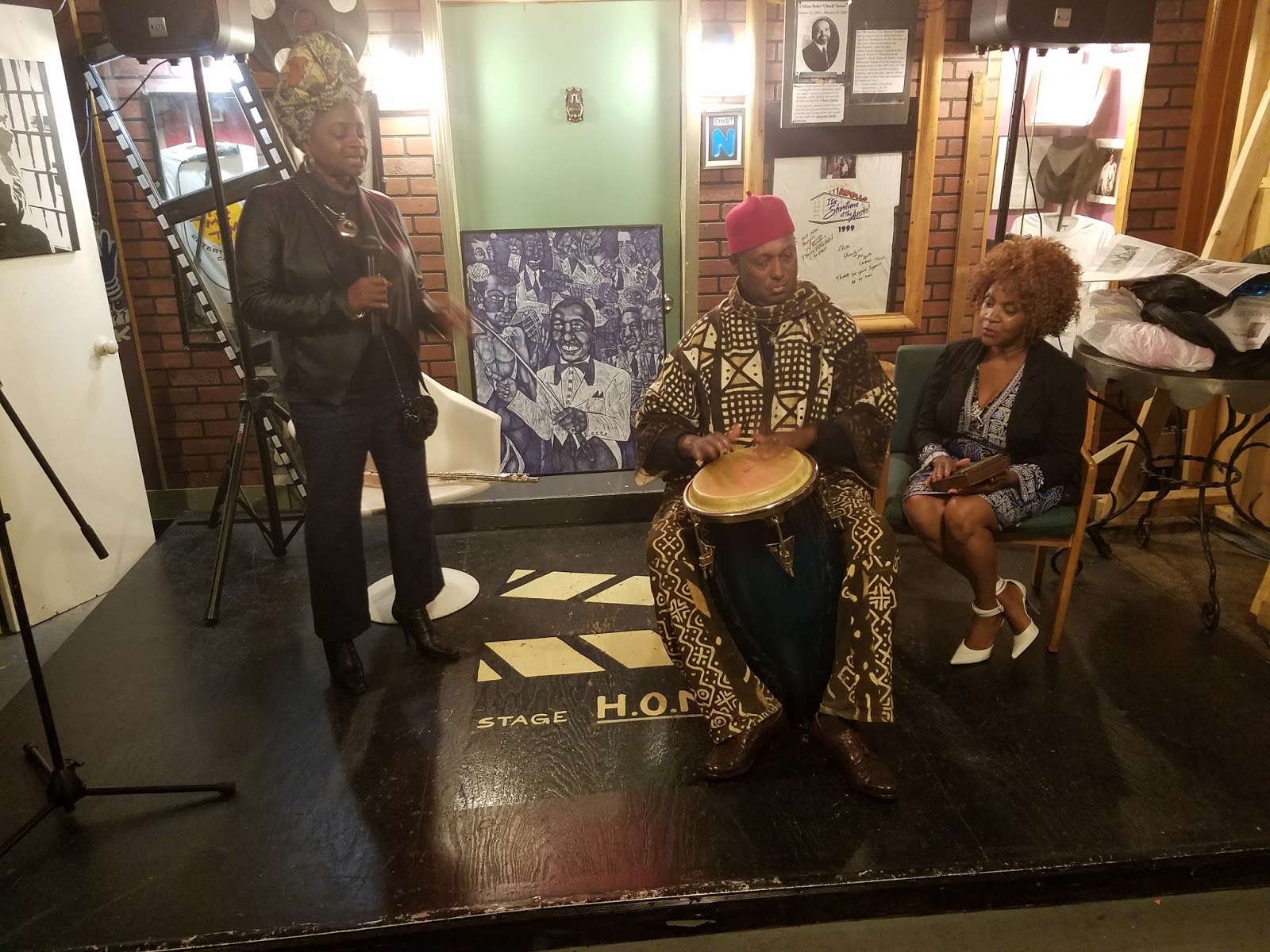
Caquita Monique sings, Ekpe Abioto plays the djembe drum, and Deborah Gleese
Barnes strokes the kalimba during The Jimmie Lunceford Jamboree Jazznocracy
Concert at the House of Mtenzi. (Photo by Wiley Henry)
The melodious jazz music that Jimmie Lunceford made famous during the swing era was buried with him in 1947 at historic Elmwood Cemetery in Memphis. The alto saxophonist and bandleader was only 45 years old when the music went silent.
Silence pervaded throughout the decades and Lunceford faded into obscurity – until an artist, musician, activist and historian discovered the maestro’s musicianship and his integrality to swing music nearly sixty years after his death.
In late October, however, Ronald Herd II was quite perturbed that his 10-year effort to raise awareness of Lunceford had largely gone unnoticed and that he wasn’t getting much traction.
He’d spoken to an intimate group of Lunceford devotees on Oct. 28 at the House of Mtenzi in Midtown Memphis minutes before the start of the Jimmie Lunceford Jamboree Jazznocracy Concert, which he produced primarily singlehandedly.
Jimmie Lunceford
The concert was part of the first annual seven-day Jimmie Lunceford Jamboree Festival that Herd – along with his mother, Callie Herd – founded to honor the legacy of the late extraordinary bandleader in order to secure his place in the annals of history and the world of jazz music.
He’d taken to social media to amp up visibility and awareness, which included radio interviews and news stories highlighting Lunceford’s contributions to Memphis and the music that inspired other jazz greats, such as Duke Ellington, Glenn Miller and Count Basie.
“After this week people probably will have heard more about Jimmie Lunceford than any time in the last 20 years, or even before then,” Herd told the group prior to the concert. “For a black man who had done so much, he deserves the honor.”
Since Herd had captured the attention of his audience – at times while punctuating his monologue with stinging rebuke – he encouraged those not already onboard to help bring Lunceford’s legacy back to life.
 “He was the epitome of greatness,” said Herd, chief executive artivist of The W.E. A.L.L. B.E. Group Inc., a nonprofit organization. “He was the real king of swing – not Benny Goodman. Glenn Miller said it best: ‘Jimmie Lunceford has the best of all bands. Duke [Ellington] is great, [Count] Basie is remarkable, but Lunceford tops them both.’”
The “artivist” was candid during his presentation of Lunceford and his exploits in music. “He was the number one band of choice for African Americans in the county. They called him the Harlem Express,” he said.
“Everybody wanted to be Jimmie Lunceford because he had this distinctive two-beat sound. Normally the other bands [during that era] had a four-beat sound,” said Herd, noting that Stax Records, Hi Records, and even Three-Six Mafia had emulated Lunceford’s two-beat rhythm.
A student of history, Herd compiles data and information and stores them in his memory bank. When the need arises, he retrieves them at a moment’s notice to express a point or to educate those who may be barren of facts.
Like, for example, James Melvin Lunceford (his name at birth) was born July 6, 1902, on a farm near Fulton, Miss., and learned to play several instruments as a child. He matriculated at Fisk University in Nashville and arrived in Memphis in 1927.
An accomplished musician by then, Lunceford took the job of athletic director at Manassas High School, where he organized a student band called The Chickasaw Syncopators. He later changed the name to The Jimmie Lunceford Orchestra.
The Orchestra soon rose to fame playing venues like The Apollo Theater in New York and The Cotton Club in Harlem, also in New York. He also toured extensively in Europe. But Lunceford was more than the music that he loved and shared with the world.
“He saw music as a rite of passage for young black boys and girls [to become] men and women,” said Herd. “He took the time to invest in people.”
Education and cultural awareness are essential to understanding Lunceford and the “excellence” of African Americans pursuing their dreams, he said.
“You must know where you come from and who your people are,” said Herd.
A brass note was dedicated to Lunceford on Beale Street in 2009.