Showing posts with label W.E. A.L.L. B.E. Group Inc.. Show all posts

Friday, December 27, 2024

Historical Marker Honoring Fort Pillow Massacre Vandalized


Vandals toppled this historical marker at Memphis
National Cemetery, which honors the U.S. Colored
Troops massacred at the Battle of Fort Pillow on
April 12, 1864. (Courtesy photo)

MEMPHIS, TN – A historical marker commemorating the “massacre” of hundreds of U.S. Colored Troops who fought in the American Civil War at the Battle of Fort Pillow in Henning, Tenn., was vandalized on Aug. 7, 2024, at Memphis National Cemetery, 3568 Townes Ave.

Dr. Callie Herd was livid when she was notified by the director of the cemetery that vandals had decapitated the marker. But then she couldn’t believe that someone would be so brazen that they would seek to destroy history.

The historical marker was erected to call attention to the colored troops who were “killed or mortally wounded” on April 12, 1864. Many of them, Herd said, were buried in more than 100 unnamed graves at the cemetery.

“I don’t know if it was unintentional or if somebody was actually trying to break it,” said Herd, an educator, senior programmer for FedEx, and vice-president of the W.E. A.L.L. B.E. Group Inc.

The historical marker was first unveiled in 2018 during a ceremony sponsored by the W.E. A.L.L. B.E. Group Inc., an umbrella organization advocating for responsible social entrepreneurism and activism via the arts, media, and education.

With support from the Memphis chapter of the Association for the Study of African American Life and History (ASALH), Joe Williams, whose great-great grandfather, Peter Williams, survived the massacre, the unveiling was one of the signature events for Juneteenth that year.

Herd and her son, Ronald C. Herd II, first began honoring the victims of the Fort Pillow massacre in 2016. He is the president of the W.E. A.L.L. B.E. Group Inc. The colored troops were lost to history until the Herds decided to tell their story.

But all is not lost. Herd solicited help to pay for a replacement marker. Shelby County Commissioner Henri E. Brooks, who represents District 7, and Commissioner Mickell M. Lowery, representing District 8, answered her call. 

“So those two raised the funds for us to redo the marker,” Herd said. “She (Brooks) didn’t think that it should be repaired, but redone.”

Herd said the people whom she had contacted were devastated at the thought of the marker getting destroyed. It was Brooks, she noted, who encouraged her to file a police report with the Memphis Police Department.

Since the damaged marker bears the seal of the Bureau of Colored Troops (1863-1867), U.S. Army Artillery, Herd filed another application, this time with the Shelby County Historical Commission at Brooks’ behest.

“By it being destroyed, it helped us to get the seal that we wanted from the start,” Herd said. “That way it’s validated as a historical landmark rather than just us doing it by ourselves.”

The language on the marker reads in part: “Eyewitnesses reported that black soldiers were killed despite putting down their weapons and surrendering in what the North deemed a massacre.”

The word “massacre” elicited a debate in some circles. Should it be used to describe many of the “179,000 African-American soldiers who fought to free the country from the scourge of slavery?” 

“It was a massacre,” Brooks contends. “If it (language) is not accurate, it’s not history.”

Herd said the replacement marker has been approved and the paperwork has been started. Someone told her, she said, that the marker will take about six or seven months to complete.

“We want to reinstall the marker on Juneteenth of 2025,” she said. 

Brooks said without reservation that if the replacement marker is damaged again or destroyed, she’d replace it again and again.

“Remember Fort Pillow” is inscribed on the historical marker in a bold font. Herd hopes the cemetery will continue to honor the U.S. Color Troops long after she’s gone.

Copyright 2024 TNTRIBUNE. All rights reserved.

Thursday, November 30, 2017

Bringing Jazz Great Jimmie Lunceford’s legacy back to life

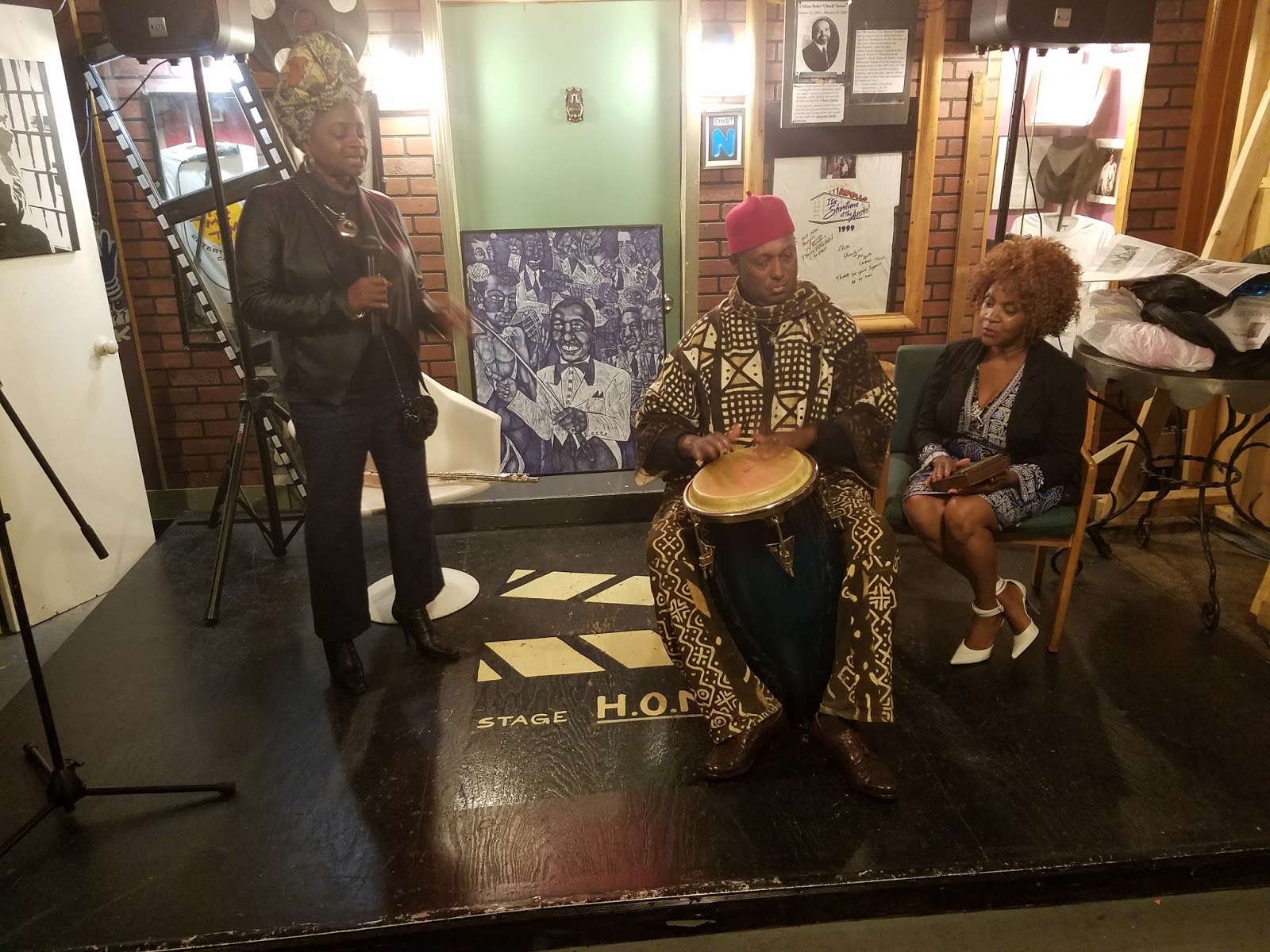
Caquita Monique sings, Ekpe Abioto plays the djembe drum, and Deborah Gleese
Barnes strokes the kalimba during The Jimmie Lunceford Jamboree Jazznocracy
Concert at the House of Mtenzi. (Photo by Wiley Henry)
The melodious jazz music that Jimmie Lunceford made famous during the swing era was buried with him in 1947 at historic Elmwood Cemetery in Memphis. The alto saxophonist and bandleader was only 45 years old when the music went silent.
Silence pervaded throughout the decades and Lunceford faded into obscurity – until an artist, musician, activist and historian discovered the maestro’s musicianship and his integrality to swing music nearly sixty years after his death.
In late October, however, Ronald Herd II was quite perturbed that his 10-year effort to raise awareness of Lunceford had largely gone unnoticed and that he wasn’t getting much traction.
He’d spoken to an intimate group of Lunceford devotees on Oct. 28 at the House of Mtenzi in Midtown Memphis minutes before the start of the Jimmie Lunceford Jamboree Jazznocracy Concert, which he produced primarily singlehandedly.
Jimmie Lunceford
The concert was part of the first annual seven-day Jimmie Lunceford Jamboree Festival that Herd – along with his mother, Callie Herd – founded to honor the legacy of the late extraordinary bandleader in order to secure his place in the annals of history and the world of jazz music.
He’d taken to social media to amp up visibility and awareness, which included radio interviews and news stories highlighting Lunceford’s contributions to Memphis and the music that inspired other jazz greats, such as Duke Ellington, Glenn Miller and Count Basie.
“After this week people probably will have heard more about Jimmie Lunceford than any time in the last 20 years, or even before then,” Herd told the group prior to the concert. “For a black man who had done so much, he deserves the honor.”
Since Herd had captured the attention of his audience – at times while punctuating his monologue with stinging rebuke – he encouraged those not already onboard to help bring Lunceford’s legacy back to life.
 “He was the epitome of greatness,” said Herd, chief executive artivist of The W.E. A.L.L. B.E. Group Inc., a nonprofit organization. “He was the real king of swing – not Benny Goodman. Glenn Miller said it best: ‘Jimmie Lunceford has the best of all bands. Duke [Ellington] is great, [Count] Basie is remarkable, but Lunceford tops them both.’”
The “artivist” was candid during his presentation of Lunceford and his exploits in music. “He was the number one band of choice for African Americans in the county. They called him the Harlem Express,” he said.
“Everybody wanted to be Jimmie Lunceford because he had this distinctive two-beat sound. Normally the other bands [during that era] had a four-beat sound,” said Herd, noting that Stax Records, Hi Records, and even Three-Six Mafia had emulated Lunceford’s two-beat rhythm.
A student of history, Herd compiles data and information and stores them in his memory bank. When the need arises, he retrieves them at a moment’s notice to express a point or to educate those who may be barren of facts.
Like, for example, James Melvin Lunceford (his name at birth) was born July 6, 1902, on a farm near Fulton, Miss., and learned to play several instruments as a child. He matriculated at Fisk University in Nashville and arrived in Memphis in 1927.
An accomplished musician by then, Lunceford took the job of athletic director at Manassas High School, where he organized a student band called The Chickasaw Syncopators. He later changed the name to The Jimmie Lunceford Orchestra.
The Orchestra soon rose to fame playing venues like The Apollo Theater in New York and The Cotton Club in Harlem, also in New York. He also toured extensively in Europe. But Lunceford was more than the music that he loved and shared with the world.
“He saw music as a rite of passage for young black boys and girls [to become] men and women,” said Herd. “He took the time to invest in people.”
Education and cultural awareness are essential to understanding Lunceford and the “excellence” of African Americans pursuing their dreams, he said.
“You must know where you come from and who your people are,” said Herd.
A brass note was dedicated to Lunceford on Beale Street in 2009.