Showing posts with label Memphis. Show all posts

Saturday, June 1, 2019

Juneteenth returns to Robert R. Church Park June 14-16

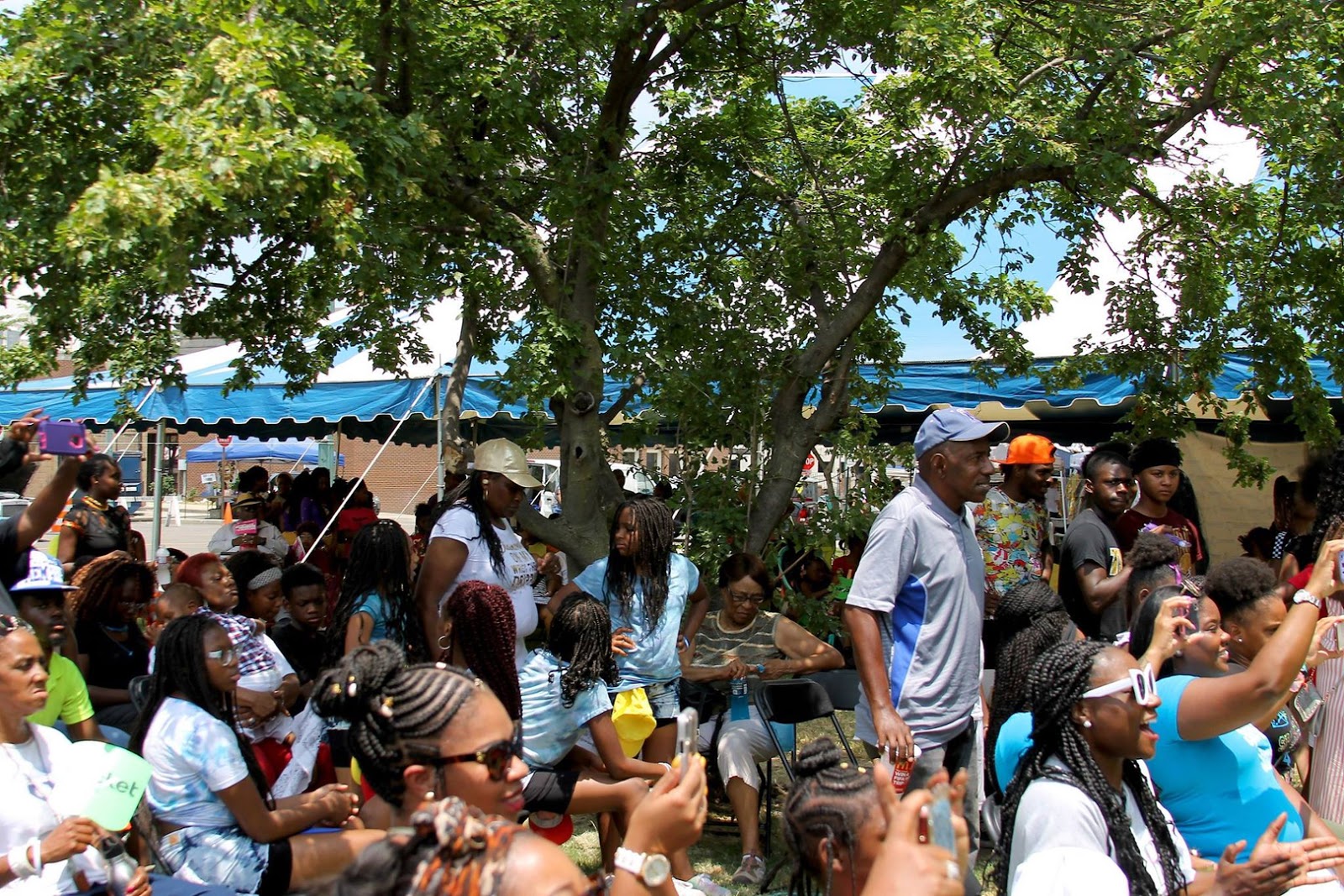
Relaxing underneath the canopy of a shade tree, revelers listen as music reverberates
from the stage at last year's Juneteenth Urban Music Festival in historic Robert R.
Church Park. (Photos by Lakendrex McNeil)
When history and culture converge at the historic Robert R. Church Park in downtown Memphis June 14-16, revelers on the ground will experience the best that the Juneteenth Urban Music Festival has to offer.
“We’re working hard to bring Memphis the best in music, food and entertainment,” said Telisa Franklin, the festival’s president/CEO. “We’re expecting somewhere around 40,000 people to attend the three-day festival.”
Memphis is ripe for such a festival as Juneteenth, where children, adults and entire families come together to support one of Memphis’ longest running African American festivals – now celebrating 27 consecutive years of fun and excitement.
An estimated 40,000 people are expected to revel in the
park during the three-day festival.
“The festival is a staple in Memphis,” said Franklin. “Festivalgoers can look forward to another year of eclectic music, choirs, entertainment, arts and crafts, food vendors, majorettes, dancers, steppers, cheerleaders, a car and bike show, activities for seniors and kids and more.”
The artists line-up for the weekend include the Tennessee Mass Choir, Pam Armour and The Memphis Shop, Courtney Little, Wendell Weathers & Greater Purpose, the Disciples of Mime, Tabitha Adams, Brandon Lewis, Sherry Self, Diamond Praise Dance Company, Donte Everhart & End Time Movement, Hope Church, and many more.
The festival is open to the public.
Prior to the three-day festival, festivalgoers can look forward to the Juneteenth Career and Health Fair Expo on Tuesday, June 11, from 10 a.m. to 2 p.m., at J.I.F.F., 254 S. Lauderdale St. Job seekers will get an opportunity to talk to dozens of potential employers.
“We advise job seekers to bring their resumes and dress for success,” said Franklin. “This year the Shelby County Reentry Program will provide assistance to help felons. We just want to provide a service for those who are having a hard time.”
In addition to the Juneteenth Career and Health Fair Expo, attendees can look forward to the Memphis Juneteenth Lifetime Achievement Awards on Thursday, June 13, at the Holiday Inn University of Memphis, 3700 Central Ave.
The awards program will begin at 7 p.m. and include dinner and an original play, “I Know Who I Am,” written by local playwright Dr. Sharli Kay Adair, Juneteenth’s director of operations.
The honorees include The Rev. Ricky Floyd, pastor of Pursuit of God Transformation Center; Sheila Whalum, first lady of New Olivet Baptist Church; Gina Y. Sweat, director of Memphis Fire Services; Bishop Wesley J. Arije, Presiding Bishop and Chief Apostle of the March of Faith International Fellowship, Inc.; Vincent Tharpe & Kenosis; Shania Brown, a young filmmaker, producer and actress; Stanley Smith of Erole’s Expose Modeling Agency; Felecia Bean Barnes of Felicia Bean Catering & Food Service; choir director Adrian Maclin; Gwendolyn Turner, co-founder, Billy Rivers and the Angelic Voices of Faith, Inc.; Memphis Police Director Michael Rallings; and Timothy Mason, Grammy nominated and Stellar Award-winning musician, producer and writer.
On Friday, June 14, from 10 a.m. – 10 p.m., the Juneteenth Urban Music Festival officially begins with live stage performances, activities for seniors, a number of vendors, and Kids Zone, with rides, games and inflatables.
There will be a mobile outdoor educational museum on the grounds each day depicting the history of Juneteenth, including the abolition of slavery and the facts surrounding President Lincoln’s Emancipation Proclamation.
The next day – Saturday, June 15, from 10 a.m. – 11 p.m. – live stage performances will continue in addition to the “Juneteenth Ultimate Dance Showdown,” featuring the “best of the best” majorettes, dancers, steppers and cheerleaders. Other activities are scheduled for the youth and the entire family as well.
Sunday, June 16, is “Food Truck Sunday” and “Praise Fest at Juneteenth,” featuring gospel music, inspirational and encouraging words spoken by ministers, preachers and gospel artists and more from 12 p.m. – 10 p.m. Some of Memphis’ most talented choirs, singers and musicians will take center stage.
 “Juneteenth is here to stay. We celebrate our freedom from slavery because it is important that we don’t forget where we came from,” said Franklin. “This is an opportunity for all of us, including other ethnicities, to eat, dance, worship and be merry.”
Juneteenth is a national holiday in the United States commemorating the abolition of slavery and the freeing of the last African-American slaves in Galveston, Texas, on June 19, 1865. The commemoration began in Memphis 27 years ago.
(For more information about the Juneteenth Urban Music Festival, contact Telisa Franklin at 901-281-6337 or log on to www.memphisjuneteenth.com.)

Thursday, December 29, 2016

Dr. LaShondra Jones helps veterans mired in the criminal justice system

The affinity that Dr. LaShondra Charmaine Jones has shown veterans was apparent after conversing with a Vietnam-era veteran in 2012 while volunteering at a reentry facility in Houston, Texas.
“The facility specifically focuses on men who’ve been incarcerated 20 or more years,” said Jones, a native Memphian who graduated Dec. 10, 2016, from Texas Southern University in the Barbara Jordan/Mickey Leland School of Public Policy.
Dr. LaShondra Charmaine Jones
 After nearly four years of study, Jones, 41, scrolled upfront in cap and gown during the graduation ceremony in the Health and Physical Education Arena to receive her Doctor of Philosophy degree in the Department Administration of Justice.
She had penned her dissertation on veterans who served gallantly during Operation Enduring Freedom/Operation Iraqi Freedom and their post-combat involvement in criminal activity.
It was aptly titled “An Analysis of the Resiliency and Criminal Justice Involvement of Combat Veterans.”
The conversation that Jones had with the veteran sparked her interest in the more than 21 million veterans in the United States – according to the Census Bureau’s 2014 figures – who find themselves caught up in a bureaucratic labyrinth that they can’t seem to navigate.
This veteran, whom Jones befriended, had spent more than 30 years in prison and lost his right to vote. “He said, ‘I’m on paper until about 2040. I’m already in my 60s and I’ll never be able to vote again.’”
Jones, a veteran herself, enlisted in the U.S. Marine Corps at 17. She served four years of active duty and was honorably discharged in 1998. Consumed by compassion, she couldn’t believe what she’d heard and wanted to do something about it. The man had paid his dues, she said, but that wasn’t enough.
“The first job that he got when he was released from prison is the same job that he’s still on. He’s constantly getting promoted. He’s been on the job about seven or eight years,” she said.
“For me, that just took my breath away,” Jones continued. “You have a Vietnam veteran that was drafted, served his country, and came back… so [they] turn to drugs and alcohol, crime, because of the things that they’d experienced and were exposed to in Vietnam.”
If the man’s criminal record can’t be expunged, he’d never be able to vote, she pointed out. “He’s served his time, served his country. He’s a law-abiding citizen and no longer can gain his right to vote.”
Jones had traded Memphis for Houston in 2011 in search of a new perspective, to pursue her doctorate, and to secure a decent job in her chosen field. She’d already earned a bachelor’s degree and a master’s degree from the University of Memphis after concluding her service in the U.S.M.C.
But something was stirring in Jones. She sought to right what she deemed to be wrong with the treatment of veterans. She studied law, served as a paralegal, and worked for the county attorney’s office in Memphis.
“My goal was to get involved in law some kind of way,” said Jones, who was raised by her mother, Teresa McGlothlin.
While working at a homeless facility for veterans in Houston, for example, Jones noticed the challenges they were confronted with. Crime had run amok among the veterans and mental illness was pervasive.  
“You have a lot of decorated soldiers that are homeless,” she said, “because they’ve become involved in the criminal justice system. Now you have Purple Heart [recipients] sleeping in homeless shelters.”
Jones currently works as a program coordinator in Houston for Catholic Charities in the Pathways to Hope/Lotus Project program to help women veterans regain their “resiliency” and “self-sufficiency.”
In 2015, she interned as a policy associate with State Sen. Rodney Glenn Ellis’s Texas Legislative Internship Program during the 84th Texas Legislative Session and focused on legislation that impacted veterans.
“The first thing they did was placed me with a policy firm that allowed me to focus specifically on veterans legislation,” said Jones, who testified several times before the Texas House and Senate on behalf of veterans.
“I got opportunities to meet a lot of legislators and they began to defer to me about veterans,” she added.
Jones attends national conferences across the country to learn more about veterans. She served three terms on the Texas Veteran Commission Funds for Veteran Assistance and was the first African American and first female to be elected chairman and vice-chairman of the board.
She also is active in the Houston Branch NAACP, where she serves as vice-chairman of the Armed Forces Committees. Her short-term goal is to move to Washington, D.C. to lobby for veterans.
“I would like to be a part of the Senate one day,” said Jones, hoping someday to toss her hat into the political ring. “Who knows?”

Friday, September 9, 2016

There’s no denying the success of The Southern Heritage Classic

Looking back more than two decades ago, Fred Jones Jr. recalls the day he took a leap of faith – and a long with that leap a combination of moxie and aptitude – to create, package and brand the Southern Heritage Classic as one of Memphis’ biggest sports/entertainment venues.  
“I had no track record in producing an event like this in Memphis, even though I was traveling all over the country participating in events already,” said Jones, who started out as an entertainment promoter. Even the “city fathers did not believe I could pull the Classic off.”
Fred Jones Jr.
And since rivals Tennessee State University (TSU) and Jackson State University (JSU) were part of the equation, Jones had to convince the administration at both schools that he knew what he was doing. It was a tough sell, he said, even though the schools’ athletic directors were on board, but believed the game should be played on the gridiron in Memphis.
Twenty-seven years later, the two HBCUs (Historically Black Colleges and Universities) will romp the gridiron once again on Saturday, Sept. 10 at 6 p.m. before an expected 50,000-plus Classic fans cheering on their favorite team, or alma mater, at the Liberty Bowl Memorial Stadium.
The football game is the Classic’s signature event. However, prior to the kickoff, fans will be privy to other classic events over the course of three days – Sept. 8-10 – which includes two star-studded concerts, a parade, a fashion show, a golf tournament, and tailgating.
“You never know where anything will go,” said Jones, who was determined to see his idea come to fruition and to prove his naysayers wrong. “To get to 27 [years] is mission accomplish.”
In terms of corporate support, community involvement, government participation, and monetary value, what Jones has accomplished since the onset is tantamount to reaching the summit, a word he uses in the name of his company, Summit Management Corporation.
“As you track us over these first 26 years, the level of participation from corporate has increased,” said Jones, noting that FedEx has been a presenting sponsor for more than 20 years. “You can see the level of participation and the quality of our presentation.”
TSU and JSU can count on a payday of $325,000 apiece for their participation. The city of Memphis is reaping benefits as well, as residuals continue to be added to the coffers ever since Jones transformed a two-dimensional idea into an entertainment reality.
“You can’t deny the success of the Classic,” he said. “You can’t deny how the community feels about the event. You can’t deny that this is a quality event that has an impact on the community in many ways. The impact and the numbers are very clear.”
Jones said the combined total has been $10 million dollars over the course of the Classic. “But when you look at the numbers, the tale of the tape, it speaks volumes. Every survey that’s been done – the last one was two years ago – indicated that there’s a $21 million impact on the city of Memphis.”
But some people still think the “glass slippers will slip off any moment,” said Jones, who doesn’t entertain negatives. In fact, he has a contract with both schools through 2019. “We had preliminary discussions about going forward up to 2024. It’s an ongoing process.”
The enthusiasm for the Classic hasn’t waned over the years, which is good news to Jones, who intends to quarterback the Classic for years to come. Then he’ll toss it to someone who’ll take it farther than where he’s been able to take it.
“It [Classic] was built to get to 27, to 50 [years],” said Jones, noting that his son, Nathanial Jones, is “very capable” of stepping in and keeping the event going. “I want the event to go on forever. It will go on as long as there is support for the event from fans, the government, and corporate.”
If there is a barometer for Jones’ success, it is this: “As long as the people are giving me clear indications that they are satisfied with the work that we’re doing, we’ll be good.”
For more information, visit www.southernheritageclassic.com or call the Summit Management Corporation at (901) 398-6655 or 1-800-332-1991.

Sunday, September 27, 2015

Can Memphis do what Nashville has done and elect a woman mayor?

     
Dr. Sharon A. Webb, the only woman in the 2015 Memphis mayoral race,
faces an uphill battle against formidable opponents. (Photo by Wiley Henry)
       Dr. Sharon A. Webb’s campaign for mayor could end up dead on arrival in the Memphis municipal election on Oct. 8 after failing to resuscitate a poor debate performance at First Congregational Church on July 28.  
Webb is the only woman on the ballot in the mayor’s race and made that point explicitly clear throughout the debate and from that point forward on the campaign trail. “I am the only woman in this race,” she said. “And we need a woman in that office.”
Webb’s point is well taken. But women have not been successful in their bid for the mayor’s job, said attorney Carol Chumney, who ran unsuccessfully for Shelby County mayor in 2002, city mayor in 2007 and again for city mayor in the 2009 special election.
 “I would hope people during some point will give a woman a chance,” said Chumney, a former state legislator and city council member. “We’ve got a lot of qualified women in this city and state. It’s time to break the glass ceiling. All people want is a level playing field.”
The glass ceiling was broken just recently in Nashville when Megan Barry became the first Metro Council member to be elected mayor. She beat David Fox 55 percent to 45 percent after a five-week run-off to become the first female mayor to head the metropolitan government.
But is it pure conjecture or wishful thinking on Webb’s part to believe that she could become the first female mayor of Memphis? Her performance in July, however, just didn’t jell with some voters and drew harsh criticism. To put it kindly, Webb is in a league of her own, one she believes is undergirded by divine intervention.
 “I do believe in miracles,” said Webb, the founder and senior pastor of Life Changing Word Ministries World Center. “I do believe in divine intervention. I feel good about the race. I feel I have just as good a chance as the other candidates.”
So what drives Webb to hedge her bets against four well-financed, politically astute front-runners – Mayor A C Wharton Jr., Councilman Jim Strickland, Councilman Harold Collins, and Mike Williams, president of the Memphis Police Association?
 “The city is going down,” she said. “The city needs to be nurtured back to health. I’m a nurturer. I know how to love the city back to life. Right now, a man doesn’t know how to fix it – and I do. I’m in the trenches every single day. I see what the people need.”
Like Chumney and a field of other contenders, Webb ran for mayor in the 2009 special election. Wharton ultimately won after ending his seven-year tenure as Shelby County mayor. But Webb loss more than she’d bargained for in that race when she drew a blank during a televised forum after she was asked about two actions she would take as mayor.
Webb admits being intimidated by her well-known opponents: Wharton, Councilman Myron Lowery, attorney Charles Carpenter, WWE standout Jerry “The King” Lawler, former school board member Dr. Kenneth T. Whalum Jr., Robert “Mongo” Hodges, former City Council member Wanda Halbert, to name a few.
“During that time I was so afraid,” said Webb. “Fear gripped me and my mind just went blank. It wasn’t that I couldn’t think of an answer, or didn’t know the answer, I just went blank.”
Webb is facing Wharton again and others who are just as formidable and well known. But is she intimidated this time on the campaign trail? Or has she learned to craft her answers to avoid being subjected to mockery and unflattering remarks?   
 “If I didn’t love the people, do you think I would put myself through this again? I care about people, so I can look pass that. The need is greater than what they write or say about me. That’s why I keep moving in spite of the ridicule.”
Despite Webb’s perceived shortcomings – and she admits not being a great debater – Chumney acknowledges Webb’s affability “and a person of faith whose heart is right.” But will these attributes translate into votes and bring her within striking distance of City Hall?
“We’ve had an African-American county mayor, an African-American city mayor, African-American county commissioners and African-American city councilmen and women, but we haven’t had a woman in the mayor’s office,” said Chumney, noting the degree of difficulty for a woman to become the chief executive officer.
There is an exception: Former Shelby County Commissioner Joyce Avery served 45 days as the interim county mayor after Wharton took office at City Hall. Avery made history, but the Commission appointed Joe Ford to fill the remaining nine months of Wharton’s term.  
Former commissioner and businesswoman Deidre Malone, the Democratic nominee for mayor of Shelby County in 2014, tried to wrest the seat from incumbent Republican Mayor Mark H. Luttrell Jr., but she suffered a disappointing loss in the general election.
There are 10 mayoral candidates on the Memphis ballot altogether. But the spotlight hasn’t landed squarely on the so-called lower-tier candidates, which could elevate their profile significantly like the profiles of the big four: Wharton, Strickland, Collins and Williams.
“The media selected four candidates. It’s not fair and it’s not right when there are 10 people in the race,” lamented Webb, who was invited to participate in just a couple of forums or debates although there have been several.
“They didn’t invite me to the forums and debates because they don’t think I’m qualified,” she said. “That’s their choice, but it isn’t right.”
Webb has some political experience. She was elected to the school board of legacy Memphis City Schools and the Memphis Charter Commission, a body that reviewed and suggested changes to the city’s charter.
“It didn’t say you have to have 15 years of government experience,” said Webb, noting that her qualifications to run for mayor put her on the ballot. “When you work in a job or an administration you learn on the job.”
It’s a huge challenge for any woman, Chumney maintains. “Are we holding women to too high standards? Are we sexist? These are questions I grapple with. So how do you break the glass ceiling? You can’t break the glass ceiling unless you run.”
Webb says she’s not discouraged even though huge barriers are blocking her path to City Hall. “I refuse to allow anybody to put me in a box and say what I can’t do. It takes courage to stand up there, to put your name on the list. It takes Jesus.”
It also takes a lot of money to run a successful campaign. “Having $400,000 in your war-chest doesn’t make you a winner. It’s the voters,” said Webb, referencing the huge war chests amassed by the top two contenders, Wharton and Strickland.
“You don’t have to have billboards to win an election,” said Webb, running a grass root campaign instead. “Sometimes it gets hard, but you just get out your Kleenex and keep running. You have to encourage yourself. And I’m going to run to the end.”


Friday, January 23, 2015

The transformation of public housing in Memphis

     By 2016, the demolition of the last of Memphis’ large public housing developments for families could end the “warehousing” of some of the city’s poorest African-American residents and literally wipe clean the last vestiges of family public housing forever.
     The William H. Foote Homes, located on Danny Thomas Boulevard north of Mississippi Boulevard, was built in 1940 for low-income families. It is the last of the city’s public housing developments that was home to innumerable families from the onset.
University Place, built on the site of the Lamar Terrace
housing project. (Photo: Wiley Henry)
     The first tenants who took a survey were “gratified” to transition to their new digs with “inside toilets, adequate heating, and electricity,” according to a newspaper article during that period on an addition to Foote Homes.
     But the blueprint for housing the city’s indigent families is being revamped. There was merit in public housing; however, arguments abound over whether or not poverty, errant behavior, unsanitary conditions, and criminal activity come into play when there are large concentrations of people.
     “Crime is a result of poverty to some extent,” Robert Lipscomb, director of Housing and Community Development (HCD) and executive director of Memphis Housing Authority (MHA), reasons. “So we have to reduce poverty. And when you do that, you will see a reduction in crime.”
     Lipscomb is the face of public housing dismantlement and a proponent of replacing them with modern mixed-income communities. “We have to make sure that people have a good place to live, a choice of where they want to live,” said Lipscomb.
Lamar Terrace before it was redeveloped into University
Place. (Photo courtesy of Memphis Housing Authority)
     Although more than 400 families remain at Foote Homes, the fate of the 420-unit development is contingent on a Choice Neighborhoods Implementation Grant from the U.S. Housing and Urban Development (HUD) that will be used to raze the development and replace it with a new community of mixed-income residents.
     Memphis was among four finalists vying for the grant in 2013, but was not one of the three cities that HUD selected. Lipscomb, however, is determined to secure the grant. A new development team is working diligently to meet the Feb. 9 deadline for the next round of funding some time in June or July.
     If Memphis is awarded the HUD grant, Lipscomb said, “We’ll be one of the first communities to get rid of public housing – and that says a lot about Memphis.”

MHA’s deteriorating housing stock…

     Lipscomb got his marching orders to clean up public housing nearly 20 years ago when Dr. Willie W. Herenton was the mayor of Memphis. Most developments were in disarray and conditions festered steadily to a point where they’d become blighted havens for youthful indiscretion, drugs and criminal activity.
     A Jan. 13, 1997, audit of MHA, from 1983 through June 30, 1996, was explicit and stated unequivocally that “MHA is not fulfilling its primary mission of providing decent, safe and sanitary housing for low-income families.”
     Squalor pervaded the developments and residents seemed resigned to live in such horrific conditions – those who remained. Of the 22 low-income housing developments that MHA owned and operated at that time (more than 7,000 units altogether), the large family developments suffered the most from interior and exterior decay, according to the audit.
     Several units were boarded up due to a lack of demand; others were extremely dilapidated. And deteriorated plumbing, electrical, walls/ceilings, and floors, among other infractions, were declared “unsafe.”  
     HUD’s Office of Inspector General had made it crystal clear that “MHA’s housing stock and grounds are in poor condition due to age, lack of maintenance and ineffective use of modernization funds, and have been for many years.”
     There was rampant theft, too, and people were vacating the developments, Lipscomb added.
     HUD put the city on notice with a recommendation that MHA be declared “in default of its Annual Contributions Contract (ACC), and initiate steps to obtain new management of MHA’s maintenance and modernization operations.”
     Translation: HUD was threatening to take over MHA’s operations.
     “The OIG report was horrible,” said Lipscomb, who was asked by MHA’s board of directors to replace Jerome D. Ryans, who was MHA’s executive director. Lipscomb took over in February 1999. Prior to his new duties, he’d run the city’s Housing and Community Development agency and left in 1996 to take a post at The LeMoyne-Owen College, his alma mater.
     “We were on HUD’s ‘troubled housing list’ for years (along with MHA’s Section 8 program) and was about to be taken over by HUD,” said Lipscomb.
     Problems were widespread. At the behest of Herenton, the city’s first African-American elected mayor, Lipscomb went to work. One of the mayor’s goals was to increase affordable housing for Memphis citizens.

Transforming public housing…

     MHA is the second oldest housing authority in the United States. The Memphis City Commission created it in 1935.
     The serious deterioration of public housing over subsequent decades and the “horrible” OIG report, however, precipitated a move by the Herenton administration to create something different for the city’s low-income residents.
     By the time the second African-American mayor moved into City Hall, the city was well on its way to becoming a “A City of Choice,” a tagline Mayor A C Wharton Jr. has used to pitch Memphis. The pitch includes transforming MHA’s public housing stock into a beautiful oasis of mixed-income communities with manicured lawns and ample amenities.
     Lipscomb is now working in tandem with Mayor Wharton to finish the job. The mayor once called the transformation of public housing a “revolution.” He is just as determined to make affordable housing a reality for low-income residents as his predecessor.
     LeMoyne Gardens was MHA’s first development to be demolished after receiving a $481,000 HOPE VI planning grant in 1994 and a $47.2 million HOPE VI Implementation Grant in 1995. LeMoyne Gardens was redeveloped with public and private funding and renamed College Park. A statue of Dr. Herenton, the fifth-term mayor, stands upright on its base facing his alma mater, The LeMoyne-Owen College.
     MHA has received five HOPE VI grants altogether from HUD, which set in motion the “revolution” that transformed public housing. “We had to do something,” Lipscomb said.
     Hurt Village, for example, was transformed into homes and apartments called Uptown, which was redeveloped in phases to include Metropolitan Apartments, Magnolia Terrace, Greenlaw Place, and scattered site rental units.  
     Lamar Terrace morphed into University Place. Dixie Homes was replaced with Legends Park Place and McKinley Park (on-site homeownership phase). And Cleaborn Homes is now called Cleaborn Pointe at Heritage Landing.
     Lauderdale Courts, another large family development, was redeveloped as Uptown Square with the use of mixed financing. It is also located in the Uptown area. Altogether, all five HOPE VI grants totaled $144 million.
     The unsightly developments were transformed into aesthetic environs, both residential and commercial. The HOPE VI grants were a game-changer for MHA. Still, there are other residential communities in its housing stock that have been – or are being – redeveloped, rehabilitated, or renovated.
     Foote Homes is the last family development to be demolished, which is targeted for a $30 million Choice Neighborhoods Implementation Grant. The grant “supports those communities that have undergone a comprehensive local planning process and are ready to implement their ‘Transformation Plan’ to redevelop the neighborhood.”
     The Choice Neighborhoods Implementation Grant replaces the HOPE VI grant. The Feb. 9 deadline is looming and Lipscomb and his team are making haste to meet it.
     “Around 2016, you’ll see some evidence of people moving forward,” said Lipscomb, keeping a positive attitude that the last age-old family development will go by way of the wrecking ball.

Tuesday, October 14, 2014

Nathaniel Ray Nolan: ‘I’m the World Famous Dr. of Barbeque’

      Long before the tantalizing aroma of barbecue ever wafted across Nathaniel Ray Nolan’s nostrils, pit masters in Memphis and Shelby County were already making headway in perfecting the art of barbecuing various meat products on the grill.
      It would take Nolan most of his life to master the grill. Now he’s confident that he can whet the appetite and tease the palette of those who relish good barbecue with a slather of his own specially formulated tangy/sweet barbecue sauce.
      Nolan proclaims himself the “Dr. of Barbecue,” a title he assures he can back up. No matter the competition, he says he’s “world famous,” a description he’s added to the name of his newly launched “World Famous Dr. Barbecue Sauce.”
Nathaniel Ray Nolan
      “Barbecue is who I am,” said Nolan, who barbecues and caters all types of events for a living. “Some guys are good at what they do. I’m good at what I do. It’s an art. And I am very serious about my product, my brand.”
      Nolan has been serious about barbecue since he was 6 years old living in the Binghamton community. His mother, he said, would send his father out to purchase barbecue sandwiches for the family every Friday night.
      “I thought barbecue was the best sandwich I’d ever had. Then I began craving barbeque. It was sort of like my passion,” said Nolan, recalling the savory experience that triggered an unrelenting search for the ultimate barbecue sandwich.
      “I was about 9 years old when I used to go in my mom’s pantry and get a little ketchup and a little vinegar. My dad was from New Orleans. So when she would go to New Orleans, she’d bring back all these herbs and spices,” said Nolan, the second born of seven children.
      Nolan’s passion, cravings, and insatiable appetite for barbecue never waned. He even worked at barbecue restaurants when he grew older. “I told some of the owners…I said, ‘Look, sir, you guys don’t have to pay me in cash, y’all can pay me in barbecue.’”
      The plan was to learn as much about preparing barbecue and, most certainly, the sauce. “I was trying to learn a lot about everybody’s secret sauce,” he said. “I knew that one ingredient that I would need to use was ketchup.”
      Undaunted by the secrets of other sauces, Nolan set out to make his own barbecue sauce, one that would “blow your taste buds away.” So he started experimenting, and, through trial and error, kept trying to formulate his own special sauce.
World Famous Dr.
Barbecue Sauce
      In 1977, the pit master started his first barbecue restaurant in Memphis. It was a dream come true, he said, one that he’d envisioned in his youth when he first aspired to become an entrepreneur. Even after overcoming a speech impediment, he was on his way to becoming the “Dr. of Barbecue.”
      “Because I’m the ‘World Famous Dr. of Barbeque,’ I wanted to play up to the doctor …to make sure that my barbecue sauce is healthy for the body,” said Nolan, who consulted with a chemist to ascertain the right mixture of herbs and spices for his barbecue sauce. 
      “I wanted to keep the ingredients low in sodium. I wanted to keep it a healthy, conscious barbecue sauce, which would be a great marketing tool because people are very health conscious these days,” he said.
      Taking his role seriously as the ‘World Famous Dr. of Barbecue,’ Nolan says, “If you got a pain that you can’t explain, if you got an ache that won’t wait, if you got a feeling that’s killing, you need to come see Dr. Barbecue for some nutritional healing.”
      Nolan is not shy about promoting his barbecue sauce, which he often refers to as his “Memphis Mojo Barbecue Sauce.” He also has developed a dry rub that he’s calling his M.F.E. (Miracle Flavor Enhancer). And in the very near future, he plans to introduce a wing sauce and salad dressing.
     “It’s like my little goobie dust,” he said.
     In order to prove the appeal of his sauce, Nolan has conducted several taste tests with various brand- name barbecue sauces currently on the market. “99.9 percent of people chose my sauce over the others,” he said. “This is an amazing barbecue sauce that the world needs to know about.”
      Tens of millions worldwide got a chance to see Nolan challenging Eddie Robinson in an underground barbecue cook-off via the Travel Channel. Both teams – Cordova vs. Prospect – grilled pork ribs and presented a menu that represented their neighborhoods.
      Nolan collected a hefty $10,000 grand prize for his efforts. The show aired Aug. 24. The victory, he said, imbued him with an even greater determination to see that his barbecue sauce is distributed nationwide.
     “I’m planning a 10-city tour that will start Oct. 25. Houston (Texas Southern University’s homecoming game) will be my first stop,” he said. “I’m going all across America: St. Louis, Kansas City, Dallas, North Carolina, New Orleans, Montgomery, Ala., Atlanta, Nashville.”
      The pit master also pointed out that he’s purchasing a bus to carry his team on the road. Of course, he will have in tow a big smoker that he built with a catwalk.
      “The girls will dress up in nurse uniforms. And I will dress up in a doctor’s coat and stethoscope,” said Nolan, who plans be in character as the Dr. of Barbecue.
      “I’m at the top of my game. I’m good at what I do. I’m a fulltime barbecue guru. And my blood bleeds barbecue,” he said. “My dad used to say, ‘Son, don’t brag if you can’t back it up.’” But then he added, “Bragging ain’t bragging as long as you can back it up.”

      (For more information about Nathaniel Ray Nolan or his “World Famous Dr. Barbecue Sauce,”call him at 901-314-5596)               

Friday, August 8, 2014

Luttrell gets another four years

The crowd erupted in applause at Owen Brennan’s restaurant on Poplar Avenue Thursday night after Shelby County Mayor Mark Luttrell Jr. made his way upfront to address his supporters and campaign staffers. 
       “I am so very, very appreciative of the opportunities that you’ve given me. Eight years as your sheriff, now going into eight years as your county mayor,” said Luttrell, who’d just beat Democratic challenger Deidre Malone in a hotly contested mayoral race in the county general election.
With 100 percent of precincts reporting, Luttrell’s vote total came to 90,470 (62 percent). Malone trailed with 53,376 (36 percent) votes. The decisive victory is a mandate from voters Luttrell alluded to going forward. 
       “I hope more than anything else…what we’re able to do tonight is not only celebrate this victory on election night, but also resolve to go forward with those things that we emphasized throughout the campaign that were so vital to this community,” he said.
Shelby County Mayor Mark Luttrell addresses his supporters
following an impressive win over Democrat Deidre Malone. 
       Economic development, providing a world-class education, improving the economy, protecting Shelby Countians, and managing a fiscally sound budget were some of the issues that Luttrell focused on during the campaign.
       Malone fought hard to wrest the seat from Luttrell, but came up short. She was a mayoral candidate in the Democratic primary in 2010, but lost to then-interim Shelby County mayor Joe Ford, whom Luttrell beat that year in the general. 
       Malone called to thank Luttrell on winning reelection. Later she shared part of the conversation with supporters who gathered at the Withers Collection Museum & Gallery on Beale Street.
       “I said to him that my hope is that for the next four years that you will do something great for Memphis and Shelby County. And I think it is our responsibility to make sure that he does.”
       Luttrell, she said, thanked her for “having a campaign that was honest” and one run with integrity.
       “We (during the campaign) talked about the issues because I felt that that’s what the people wanted to hear from us.”
       Malone pointed out the new ground her campaign was able to break during the primary.
       “We were able to do something in the primary that no other woman had done. We won the primary for the Democrats. And no female has won it for Republicans – so excited about that opportunity, about breaking that glass ceiling in the primary.”
       Noting that women are the majority of voters in Memphis and Shelby County, Malone said, “And we need to step up and realize that we can lead as well. So I look forward to supporting a very qualified woman, whoever comes behind me to take this on. And I am sure that someone real soon will make it happen.”
The mayor and his family. (Photos: Wiley Henry)
       Malone assured supporters that she would continue to be a voice for the working folks in the community.
       Luttrell campaign staffer Bryan Edmiston, a Cordova high school teacher, said Luttrell didn’t take anything for granted. “He made phone calls himself. I was impressed with his work ethic.” 
       Grassroots campaigning, Luttrell said, is his key to winning elections. 
       “We made 40,000 phone calls over the last six weeks. We hit the 40,000 mark yesterday (Aug. 6th). We knocked on hundreds of doors, reached out to people one-on-one and stood on street corners.”
       Dr. Melvin D. Wade said he predicted Luttrell would beat Malone based on the mayor’s record in office and the reaction from those he’d introduced the mayor to while campaigning one day in North Memphis.
      “I didn’t find a single person who said anything negative about the mayor, which, to me, was an indication they were pleased with the mayor and his administration,” said Wade, pastor of Christian Chapel Baptist Church in North Memphis. 
      “I personally felt like he’d done an excellent job in leading the county in the last four years,” he said.
       Luttrell noted the challenges that Shelby County faces, but added, “What progressively moved us forward is that we have evolved in this community to solve problems…. We’re charitable. We get involved. We step out when we’re needed. We do the things that have to be done to move us forward.”
       That includes praying, he said. “I think it’s important for those of us in public office that every night when we lay our head on that pillow we say our prayers.”
       He said he did not want to disappoint those people who trusted him, those who believed he has the skillset to make a different.
       “I want you to always feel comfortable with me, have confidence in me, and have faith in my ability to represent you as best as I can. I will continue to do that,” he said.

       (This story includes a report by Nina Allen-Johnson.)