Showing posts with label Juneteenth. Show all posts

Saturday, June 10, 2023

The Memphis Juneteenth Festival Celebrates 30 Years with Monthlong Events


This drumlins from The Memphis Youth Arts Initiative played
an integral part in last year's Memphis Juneteenth Festival.
(Photo by Wiley Henry)

MEMPHIS, TN – Juneteenth is alive and well in Memphis all monthlong and culminates June 17-18 in the 30th annual Memphis Juneteenth Festival from 10 a.m. to 10 p.m. each day at Health Sciences Park, 26 South Dunlap in the Medical District.

“We have been at the forefront in Memphis for 30 years in terms of celebrating Juneteenth,” said Dr. Telisa Franklin, the festival’s president. “Now that Juneteenth is a federal holiday, we’re excited that everybody gets a chance to celebrate.”

The celebration began June 1 with the Juneteenth Family Empowerment Fair at Ed Rice Community Center in the Frayer community. Job seekers – even budding entrepreneurs – gleaned something from participating businesses, city and county governments, recruiters, schools, and more.

Next on tap is Franklin’s Juneteenth The Musical Stage Play, Saturday, June 10, at the Holloran Centre for Performing Arts & Education, 225 South Main St. Talented singers and dancers from the Young Actors Guild (YAG) will take center stage in this adaptation of the Juneteenth experience after slaves in Galveston, Texas, learned they had been emancipated.  

Chrysti Chandler, who founded YAG 32 years ago, is the play’s creative director. Tickets can be purchased at Ticketmaster.com for either the 2 p.m. stage play or the one at 7 p.m.

“I give kudos to Chrysti for her vision, creativity, and for interpreting the story of Juneteenth from YAG’s perspective,” Franklin said. “This is a signature event for the Memphis Juneteenth Festival.” 

Up next is the Memphis Juneteenth Community Baby Shower Empowerment Luncheon, Sunday, June 11 at The Kent, from 1 p.m.-3 p.m. This event is powered by District 7 City Councilwoman Michalyn Easter Thomas and Franklin.

“The baby shower benefits expecting mothers who need to know where to go for invaluable resources,” Franklin said. “Lots of information will be available.”

There will be information on the health and wellness of mothers and their babies, including breastfeeding and free baby essentials. Topics include “Maternal Mental Health & Grief Trauma Counseling” and “Connections to Resources & Supportative Services.” 

Food, fun and, again, powerful information will be available. Registration is required. Visit www.MemphisJuneteenth.com for more information and details.

The 30th Anniversary Juneteenth Freedom Luncheon is up next, Thursday, June 15, at Holiday Inn University of Memphis, 3700 Central Ave. The grand ballroom is the setting for this 11:30 a.m. luncheon. 

Dr. Raymond Winbush, a noted scholar, activist, research professor and director of the Institute for Urban Research at Morgan State University (MSU) in Baltimore, Md., is the keynote speaker.

“If you haven’t heard Dr. Winbush expound on reparations as it relates to Juneteenth, then you’re in for a treat,” Franklin said. “He is the go-to person for African-American history and culture.”

More information is online at www.MemphisJuneteenth.com.

On Saturday, June 17, the Juneteenth Freedom 2.5 Run/Walk commences at Health Sciences Park. The 2.5K Run/Walk is significant because it took 2 ½ years before the slaves in Galveston, Texas, learned they’d been freed.

There’s a Kid Dash as well for runners ages 2-11. Medals will be awarded in each race. Participants can register online as well. 

Also on June 17, the first day of the festival, there will be a Juneteenth Greek Stroll Off. Fraternities and sororities from Historically Black Colleges and Universities will step, snap, or stomp in spirit and pride.

Other highlights of the first day include the Juneteenth Youth Showcase featuring majorettes, drummers, dancers, singers, and cheerleaders. Altogether, the two-day festival features a variety of entertainment, including arts & crafts, food vendors, a car and bike show, and activities for seniors and children.

The Memphis Juneteenth Festival is a 501c (3) organization and one of Memphis’ longest-running festivals. Memphis Mayor Jim Strickland recently proclaimed June 17-18 as “The Memphis Juneteenth Festival” and “claim this the official Juneteenth festival in the City of Memphis.”

Shelby County Mayor Lee Harris also claimed Juneteenth to be the official festival.

Saturday, May 27, 2023

Noted Scholar to Expound on Reparations at Juneteenth Luncheon


From left: Dr. Raymond Winbush, Shelby County
Commissioner Henri E. Brooks and Dr. Telisa Franklin,
president of Memphis Juneteenth Festival.

MEMPHIS, TN – Dr. Raymond Winbush is quite candid and matter of fact when he talks about the plight of African Americans, the horrors of the slave trade in America, and the case for reparations. 

He’ll seize the opportunity to expound on those topics and others when he keynotes the 30th Anniversary Juneteenth Freedom Luncheon on June 15, 11:30 a.m., at the Holiday Inn University of Memphis, 3700 Central Ave.

A reputed scholar, activist, research professor and director of the Institute for Urban Research at Morgan State University (MSU) in Baltimore, Md., Dr. Winbush’s visit is being underwritten by the Shelby County Legislative Black Caucus in partnership with the Memphis Juneteenth Festival. 

The festival commences the weekend of June 17-18 from 10 a.m. to 10 p.m. each day at Health Sciences Park, 26 South Dunlap in the Medical District.

The freedom luncheon is one of several events on tap during the month of June in observance of Juneteenth, a federal holiday since 2021. It is hosted by Dr. Telisa Franklin, the festival’s president.

“We welcome Dr. Winbush to Memphis and look forward to his keynote address. I’m sure he’ll enlighten us and provide answers to a number of questions about slavery and Juneteenth,” Franklin said.

Shelby County Commissioner Henri E. Brooks, who initiated Dr. Winbush’s visit to Memphis, said the entire community will benefit from his depth of Africa and African American history and culture.

Brooks said she first met Dr. Winbush in 1992 at an NAACP program in Nashville as an elected state representative for Tennessee’s 92nd District. She’s been enamored with his scholarship ever since. 

“I have the highest regard for Dr. Winbush,” she said. “He’s just a conscious component in our community. He’s so vital, not just for adults and students, but he’s a role model for children.”

In addition to MSU, Dr. Winbush has served as a faculty member and an administrator at Oakwood University, Alabama A&M University, Vanderbilt University, and Fisk University. 

According to his vitae on MSU’s website, Dr. Winbush is known for his “systems-thinking approaches to understanding the impact of racism/white supremacy on the global African community.”

At the freedom luncheon, Juneteenth will be the crux of his keynote address. “How do we get free in 2023?” he asked rhetorically. “We've got to liberate ourselves mentally now. And I'm going to talk about it as a meditation.” 

In other words, he said, “I don't want to just think of Juneteenth happening back in the 1860s in Texas. I want to say what do we do now? How do we liberate our people now from a lot of other things that are going on with them?”

Now that Juneteenth is a federal holiday, Dr. Winbush has mixed emotions. “That's the fastest declared federal holiday in history,” he said. “We didn’t have to even fight for it the way we did Martin Luther King's birthday way back in the 80s.”

He believes the federal holiday is “a deterrent from keeping the discussion on reparations,” which has been bandied around the U.S. House of Representatives for decades. 

The late U.S. Rep. John Conyers’ bill – H.R. 40 – is one of note. First proposed by Conyers in 1989, the bill was referred to as the “Commission to Study and Develop Reparation Proposals for African-Americans Act.”

“We got to do something to repair the damage,” said Brooks, and added that the Shelby County Board of Commissioners has discussed reparations as well. “We got to be woke about it. We got to be conscious about it.”

Reparations won’t be parceled as “40 acres and a mule,” Dr. Winbush explained, which was a redistribution of land that the federal government had promised freed Black families in 40-acre parcels after the Civil War.

“I think that reparations are going to take a variety of forms,” he said. “Some people are going to get a check; some people are going to get land; some people want to go back to Africa.”

There will be opposition to reparations, Dr. Winbush surmised, “because white people do not want to examine honestly their past.” He added: “We need to keep our eyes on the prize. And the prize is reparations.”

Tuesday, June 28, 2022

Turner Partners with Franklin to Restore Life to 'Death' Park


Atty. Van D. Turner Jr. turns over management of Health
Sciences Park to well-known personality Telisa Franklin.
(Photo by Wiley Henry)

MEMPHIS, TN – Dead people from the 1870s yellow fever epidemic were reportedly buried in unmarked graves on parkland that once stood a hospital and a memorial to an infamous Confederate general, Atty. Van D. Turner Jr. discovered during his research.

“It's just been quite interesting learning the full history of the park,” said Turner, referring to the former Forrest Park, now Health Sciences Park. 

That parcel of land is in the medical district. Once a memorial to Nathan Bedford Forrest, a slave trader and Ku Klux Klan grand wizard, now brims with new life.

“The park has always been a park of death,” said Turner, president of Memphis Greenspace, Inc., a nonprofit maintaining the park. “Now it’s become a park of life and vibrancy…of new beginnings…and celebrates life.”

“Life and vibrancy” were on display during Father’s Day weekend when the Memphis Juneteenth Festival celebrated “freedom” and “life” on the grounds that Turner once avoided and protested “what it stood for and how painful it was for my father and his generation.”

On Friday, June 24, Turner announced that Memphis Greenspace is partnering with Telisa Franklin Ministries to manage Health Sciences Park. Franklin is a businesswoman, a well-known marketer, and the festival’s president. 

Turner is still president of Memphis Greenspace, which he formed in October 2017 to legally remove the Confederate monuments to Forrest and Jefferson Davis, formerly known as Confederate Park and renamed Fourth Bluff Park. 

“We're happy with this new partnership with her,” said Turner, now contracting with Franklin to promote Health Sciences Park and enrich the green space with various activities throughout the year. 

The treelined park is conducive for all kinds of events and activities. “I think this is really a goldmine for the city,” Turner said. “I think Mrs. Franklin is the right one to carry that vision forward.”

Franklin has accepted the challenge. Now she’s gung-ho about bringing her ideas to fruition. Two callers, she said, have already expressed interest in renting the park. Turner, in his appraisal of Franklin, touted what she’s already done to unite people around an idea.

“That spot of land represented death,” Franklin said. “But in the last two years (during Juneteenth festivities), we were able to see people laugh…hug…people of different races coming together.”

Franklin said the park is for everybody in Memphis and Shelby County. “We're not excluding anyone,” she said. “We're going to create synergy and positive energy in that park.”

The stigma no longer vexes Franklin. However, in past years, she said she’d park her vehicle along the fringes of the park and just sit there. Like Turner, she was protesting, refusing to take a stroll.

The memorial to Forrest would kindle Franklin’s ire, often reminding her of what the Confederate general and slaveowner stood for. Now the equestrian statue of Forrest is gone, along with the remains of Forrest and his wife. 

While it wasn’t widely known, Turner said Forrest was exhumed and buried four times. 

After his death in 1877, Forrest was buried at Historic Elmwood Cemetery, then in Forrest Park. Then he was reburied in an unknown location in the county. Finally, Forrest and his wife were reinterred in Columbia, Tenn. 

“It's been quite the journey,” Turner said, adding, “If the park could only talk, (stories about it would unfold).”

Turner is telling a different story now: death is no longer a sidebar. He is giving Franklin the leeway to create new life in the park with monthly events and activities. 

“From this point going forward, it’s really going to be a story of joy. It’s going to be a story of resilience,” he said.  

Franklin said she’ll work to heal the land and mend hurting hearts. Education is the key, she said. But she won’t dwell on the dead. 

The aura of death will fade eventually, she said, and “life will return to the park.” 

Saturday, June 1, 2019

Juneteenth returns to Robert R. Church Park June 14-16

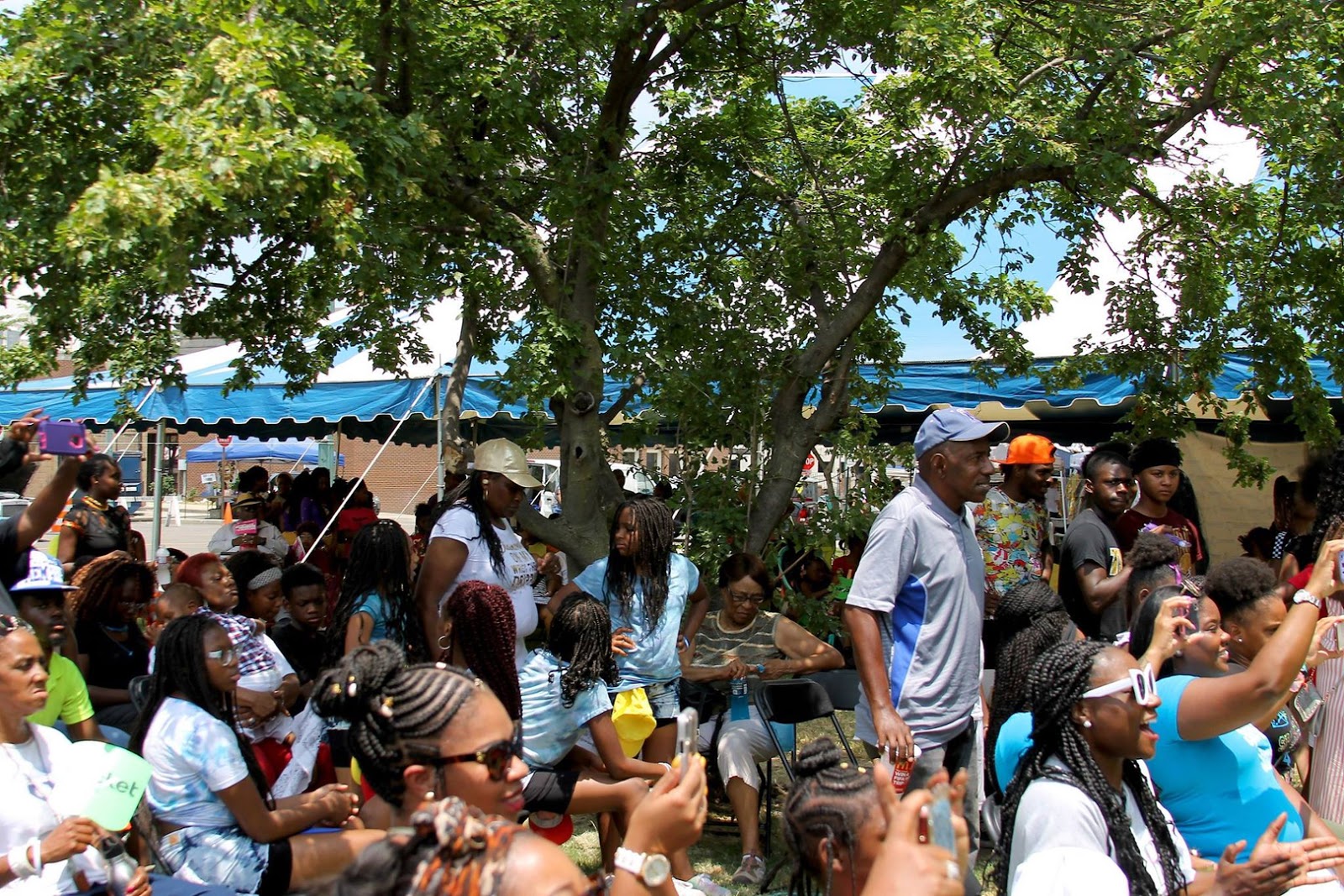
Relaxing underneath the canopy of a shade tree, revelers listen as music reverberates
from the stage at last year's Juneteenth Urban Music Festival in historic Robert R.
Church Park. (Photos by Lakendrex McNeil)
When history and culture converge at the historic Robert R. Church Park in downtown Memphis June 14-16, revelers on the ground will experience the best that the Juneteenth Urban Music Festival has to offer.
“We’re working hard to bring Memphis the best in music, food and entertainment,” said Telisa Franklin, the festival’s president/CEO. “We’re expecting somewhere around 40,000 people to attend the three-day festival.”
Memphis is ripe for such a festival as Juneteenth, where children, adults and entire families come together to support one of Memphis’ longest running African American festivals – now celebrating 27 consecutive years of fun and excitement.
An estimated 40,000 people are expected to revel in the
park during the three-day festival.
“The festival is a staple in Memphis,” said Franklin. “Festivalgoers can look forward to another year of eclectic music, choirs, entertainment, arts and crafts, food vendors, majorettes, dancers, steppers, cheerleaders, a car and bike show, activities for seniors and kids and more.”
The artists line-up for the weekend include the Tennessee Mass Choir, Pam Armour and The Memphis Shop, Courtney Little, Wendell Weathers & Greater Purpose, the Disciples of Mime, Tabitha Adams, Brandon Lewis, Sherry Self, Diamond Praise Dance Company, Donte Everhart & End Time Movement, Hope Church, and many more.
The festival is open to the public.
Prior to the three-day festival, festivalgoers can look forward to the Juneteenth Career and Health Fair Expo on Tuesday, June 11, from 10 a.m. to 2 p.m., at J.I.F.F., 254 S. Lauderdale St. Job seekers will get an opportunity to talk to dozens of potential employers.
“We advise job seekers to bring their resumes and dress for success,” said Franklin. “This year the Shelby County Reentry Program will provide assistance to help felons. We just want to provide a service for those who are having a hard time.”
In addition to the Juneteenth Career and Health Fair Expo, attendees can look forward to the Memphis Juneteenth Lifetime Achievement Awards on Thursday, June 13, at the Holiday Inn University of Memphis, 3700 Central Ave.
The awards program will begin at 7 p.m. and include dinner and an original play, “I Know Who I Am,” written by local playwright Dr. Sharli Kay Adair, Juneteenth’s director of operations.
The honorees include The Rev. Ricky Floyd, pastor of Pursuit of God Transformation Center; Sheila Whalum, first lady of New Olivet Baptist Church; Gina Y. Sweat, director of Memphis Fire Services; Bishop Wesley J. Arije, Presiding Bishop and Chief Apostle of the March of Faith International Fellowship, Inc.; Vincent Tharpe & Kenosis; Shania Brown, a young filmmaker, producer and actress; Stanley Smith of Erole’s Expose Modeling Agency; Felecia Bean Barnes of Felicia Bean Catering & Food Service; choir director Adrian Maclin; Gwendolyn Turner, co-founder, Billy Rivers and the Angelic Voices of Faith, Inc.; Memphis Police Director Michael Rallings; and Timothy Mason, Grammy nominated and Stellar Award-winning musician, producer and writer.
On Friday, June 14, from 10 a.m. – 10 p.m., the Juneteenth Urban Music Festival officially begins with live stage performances, activities for seniors, a number of vendors, and Kids Zone, with rides, games and inflatables.
There will be a mobile outdoor educational museum on the grounds each day depicting the history of Juneteenth, including the abolition of slavery and the facts surrounding President Lincoln’s Emancipation Proclamation.
The next day – Saturday, June 15, from 10 a.m. – 11 p.m. – live stage performances will continue in addition to the “Juneteenth Ultimate Dance Showdown,” featuring the “best of the best” majorettes, dancers, steppers and cheerleaders. Other activities are scheduled for the youth and the entire family as well.
Sunday, June 16, is “Food Truck Sunday” and “Praise Fest at Juneteenth,” featuring gospel music, inspirational and encouraging words spoken by ministers, preachers and gospel artists and more from 12 p.m. – 10 p.m. Some of Memphis’ most talented choirs, singers and musicians will take center stage.
 “Juneteenth is here to stay. We celebrate our freedom from slavery because it is important that we don’t forget where we came from,” said Franklin. “This is an opportunity for all of us, including other ethnicities, to eat, dance, worship and be merry.”
Juneteenth is a national holiday in the United States commemorating the abolition of slavery and the freeing of the last African-American slaves in Galveston, Texas, on June 19, 1865. The commemoration began in Memphis 27 years ago.
(For more information about the Juneteenth Urban Music Festival, contact Telisa Franklin at 901-281-6337 or log on to www.memphisjuneteenth.com.)

Saturday, August 10, 2013

Glynn Johns Reed: An enduring legacy on two fronts: Memphis and New Orleans


Glynn Johns Reed and family. From left, Reed's son and daughter-in-law, Reuben and Helen Johnson, Reed, daughter Crystal Chopin, husband Arthur Reed and grandson (Photo by Wiley Henry).

          Never one to shrink from civic responsibility or her role as standard-bearer, Glynn Johns Reed has made headway in a world where the travails of life have prevented a many African Americans -- past and present -- from realizing their true potential.
Those travails can be traced back to the slave trade. But it wasn’t until Reed matriculated at Tennessee State University in the late ‘60s that she made a conscious decision to shake up the status quo that had unleashed the fury in women such as Sojourner Truth and Fannie Lou Hamer.
“All my life I've been sick and tired. Now I'm sick and tired of being sick and tired,” said Hamer, a civil rights activist protesting her right to vote in the ‘60s.
Reed’s protest wasn’t political per se, but donning an Afro on the campus of TSU was an outward sign that she, too, was “sick and tired of being sick and tired.” She protested vehemently by celebrating her African-American ethnicity, asserting her right to be heard, and challenging a system that had given rise to Jim Crow and thus permeated Southern thinking.    
“I was with a group that burned down the ROTC building at TSU,” said Reed, disclosing a decades-old secret that no doubt baffled campus officials at the time. Though she admits not starting the fire, the sideline view she’d taken was her way of protesting the assassination of Dr. Martin Luther King Jr. and the Vietnam War, and what she’d considered to be an unjust system that had relegated African Americans to menial jobs, a back-of-the-bus experience, and an uncertain future.
That epoch was vintage Jim Crow – or somewhere afterward where unjust laws against African Americans would soon be dismantled -- but the vestiges of racism and discrimination would linger. Reed thus began asserting pride in self and in a race of people that had struggled mightily to break shackles in the arts, entertainment, education, medicine, business and other noteworthy professions before and after Reed left TSU.
“I never liked working with the system. I always bucked it. I was always in protest mode,” said Reed, who was determined to find her own way in life, including rejecting that which would bind her tenacious pursuit of self-awareness and cultural identity.
Perhaps what drove Reed’s awareness of self early on and her afro-centric bent is the fact that she grew up in the Douglass community in Memphis where the center of her universe was speckled with black people: friends, neighbors, school chums, “Mom and Pop” businesses.
“I thought it was more black people in the world,” she said, “because I grew up in a sheltered black neighborhood and went to black schools and college.”
But then something happened after Reed ventured beyond the periphery of the Douglass community in pursuit of a higher calling. “It was a culture shock when I found out there were more white people than us,” said Reed, who would solidify her pro-black stance and look for opportunities to promote the African-American experience. She also would start budding as an entrepreneur and take on a few jobs in between to support herself.
But the spark that first ignited Reed’s passion for serving her people has not been extinguished to this day – for she’s since championed from Day 1 many causes and endeavors to help as many African Americans get ahead as possible in Memphis, where she was born, and in New Orleans, a city that has shaped who she’s become today. And those who benefit the most from her sensibility and sensitivity to the African-American cause understand what motivates her to succeed.
Success, in large part, is predicated upon the persistent effort that a person puts into his or her work. And Glynn Johns Reed, who has made an inedible mark in the African-American community in both cities, doesn’t appear to be slowing down.
And why should she?
          Because Reed is at the apex of her career and has always been at the ready when transacting business or managing to be in the right place at the right time in history. Each step forward, for example, has ensured her legacy and a luminous vita in the annals of history.

Creating a business climate in New Orleans…

After graduating from Douglass in 1966 and receiving a Bachelor of Science Degree in Business Administration from TSU in 1971, Reed worked as a bookkeeper for the Memphis Urban League, took an administrative job in a sickle cell office, set up an office for acupuncturist Dr. I.K. H. Chang, worked as a commodities broker, and left for New Orleans in 1976, where she began honing her entrepreneurial skills and investing sweat and equity in the community.
            Though Memphis was slow to satisfy Reed’s insatiable appetite for social and cultural uplift, the “Big Easy,” on the other hand, drew Reed to the arts, entertainment, food, music, the business community, and the granddaddies of them all -- the Jazz Fest and the Mardi Gras. The collective experience – which started when she first set foot in New Orleans -- is simply “electric,” she said.
           “The first thing I want when I get to New Orleans is an overstuffed Shrimp Po’ boy.”
           After Reed’s acclimation to New Orleans’ culture, the entrepreneurial ideas in her head started churning. In no certain order she launched the Message Board Telephone Answering Service, started publishing the Black Pages to promote black businesses, taught aspiring models at the Barbizon School of Modeling and managed the agency for a year, performed in over 50 television commercials and movies, became a member of the Screen Actor’s Guild, and was the first black concierge hired at the Hyatt Regency Hotel, next to the Super Dome.
            “People like Dr. J (Julius Erving) and Pelé (a Brazilian soccer player) were staying at the hotel and would ask me where they could find a black restaurant or a black cab company,” said Reed, who would soon launch “An Official Guide to New Orleans,” the precursor to “The Black Pages New Orleans,” after she herself couldn’t find someone to shape her Afro. 
            “I love Memphis, but my heart is in New Orleans,” said Reed, who, within 20 years, solidified her reputation as a businesswoman and became an inextricable part of the city’s cultural mix. Her sojourn to the city along with her business acuity has enabled her to network effortlessly between Memphis and New Orleans, which earned her the moniker of “master networker.”
            It was Reed’s networking ability that enabled her to bring the first Black rodeo to New Orleans in September of ’95. The Cherokee Bill Wild West Rodeo was held at the University of New Orleans - Lakefront Arena, which honored noted cowboys such as Nat Love, also known as Deadwood Dick (1854-1921), Willie M. “Bill” Pickett (1870-1932), and James P. Beckwourth (1798-1866).
           “I introduced that culture to New Orleans,” said Reed, who was living in Memphis at that time. “People never realized there were real Black cowboys.”
           Though Reed’s parents never ventured outside the Douglass enclave to live, Reed wanted something else. So she created a haven in New Orleans that has earned her kudos from the elite and people in the community where she has a vested interest in creating a climate for African Americans to succeed.
           Reed’s two decades in the cultural mecca included building a family structure. Her son, Reuben Johnson, was born in Nashville, but enrolled in first grade at St. Louis Cathedral School. He graduated from St. Augustine High School, both within the Catholic Church, and afterward attended Nicholls State University in Thibodaux, La.
Reed’s daughter, Crystal Chopin, was born in New Orleans, and lived there for a while after she obtained her Business Administration degree at the University of Tennessee. She now lives in Memphis, after evacuating from Hurricane Katrina, and works with her mother as the multi-media coordinator for the Black Pages.   
           Reed raised Crystal and Reuben on the culture, pizzazz and splendor of New Orleans and once lived at Gov Nicholls and Dauphine, and at 601 Esplanade and Charters in The French Quarter. “When my son became an adult, he thanked me for raising him in The French Quarter,” said Reed, who’d learned much about living in an international environment as did her children.
“In New Orleans, it doesn’t matter if you’re black, white or Ethiopian. It’s a melting pot of cultures,” said Reed, recalling the blues song “Let the Good Times Roll” as an example of how she’s lived her life.

The advent of Juneteenth…

            Reed moved back to Memphis in 1991 after folding the Black Pages that she’d started in 1978. “We had a brain drain,” she explained. “When it was time to deliver the Black Pages, businesses had shut down. People were struggling and the city couldn’t cut the grass on the neutral (median) grounds.”
            Networking had come relatively easy -- perhaps innate -- for Reed. Although she left behind the ambience of New Orleans – temporarily, that is – another idea was planted in 1993 that took root in Memphis: The Juneteenth Freedom & Heritage Festival.
            Reed said the idea had come to her after her pastor at St. Paul Missionary Baptist Church had requested that she oversee the June birthday month celebration, since her own birthday is in June. “We did a Juneteenth program and 27 people showed up on a Friday evening. So they said, ‘You must take this to the community.’ So we took it to Douglass Park because of the shade trees.”
            Reed had given much consideration to the aggregation of people and wrote a proposal called “Summer in the Shade.” She presented the proposal to the executive director of Memphis in May, then a burgeoning organization celebrating the rich culture and historical significance of faraway countries to Memphis. Needless to say, the proposal didn’t go anywhere in the MIM organization.
            The first time that MIM saluted the Netherlands, Reed was busy in the office working as a bookkeeper after answering an ad in the classifieds of the local daily. The job lasted about five months, she said. During that time, “I saw how they put Memphis in May together, and it wasn’t rocket science. Their poster unveilings were also an inspiration to me.”
            What Reed had taken away from MIM was hands-on experience in organization, structure and management. But there was another side to the growing organization that troubled her the most: the artist contract-for-hire.
“If it had not been for Memphis in May, there might not have been a Juneteenth,” concedes Reed, who was teaching inner-city preteens, teens and young adults the importance of etiquette and social grace at her own Ms. Glynn’s Charm and Finishing School. Over 300 participants would graduate.
The festival has grown considerably; drawing approximately 45,000 festivalgoers during its annual three-day run in late-June. It is an anchor in North Memphis and undoubtedly one of Reed’s crowning achievements. However, after 18 years at the helm, Reed has moved on, choosing to re-focus instead on the Black Pages New Orleans.
“New Orleans is for me,” said Reed, who commutes to and fro, and still the master networker. “I want to be buried there.”
The ‘60s and ‘70s had opened Reed’s eyes to the systemic problems that negatively affected African Americans. But Reed found another way to sidestep those problems and focus on the culture, heritage and entrepreneurial spirit of her people.
Bringing African American culture and heritage into the spotlight is second nature to Reed. In 88 years, for example, the “Sojourner Truth Memorial Time Capsule” that Reed and her husband buried on June 19, 2000, in Robert R. Church Park in downtown Memphis will be unearthed to reveal the historical items from Memphis’s first Black mayor, Dr. Willie Herenton, the late photojournalist Ernest Withers, and other contributors. The time capsule was the climax of the 7th Annual Juneteenth Freedom & Heritage Festival.
“For me, it was about blackness,” said Reed, ending the conversation with her motto: “If you’re not living on the edge, you’re taking up too much space.”